
19-02-2018
07:30
Our team sorts through all blog submissions to place them in the categories they fit the most - meaning it's never been simpler to gain advice and new knowledge for topics most important for you. This is why we have created this straight-forward guide to help you navigate our system.
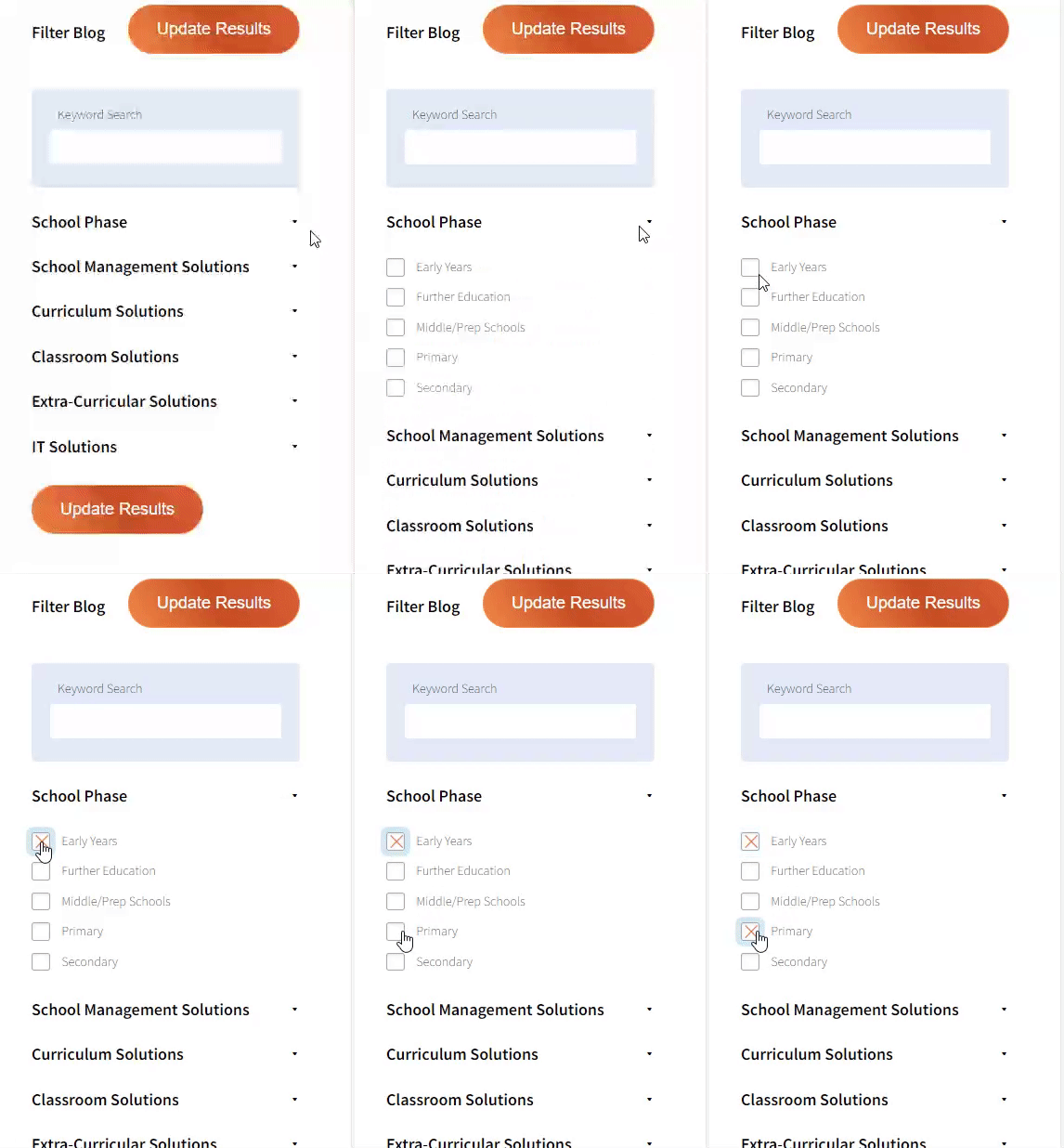
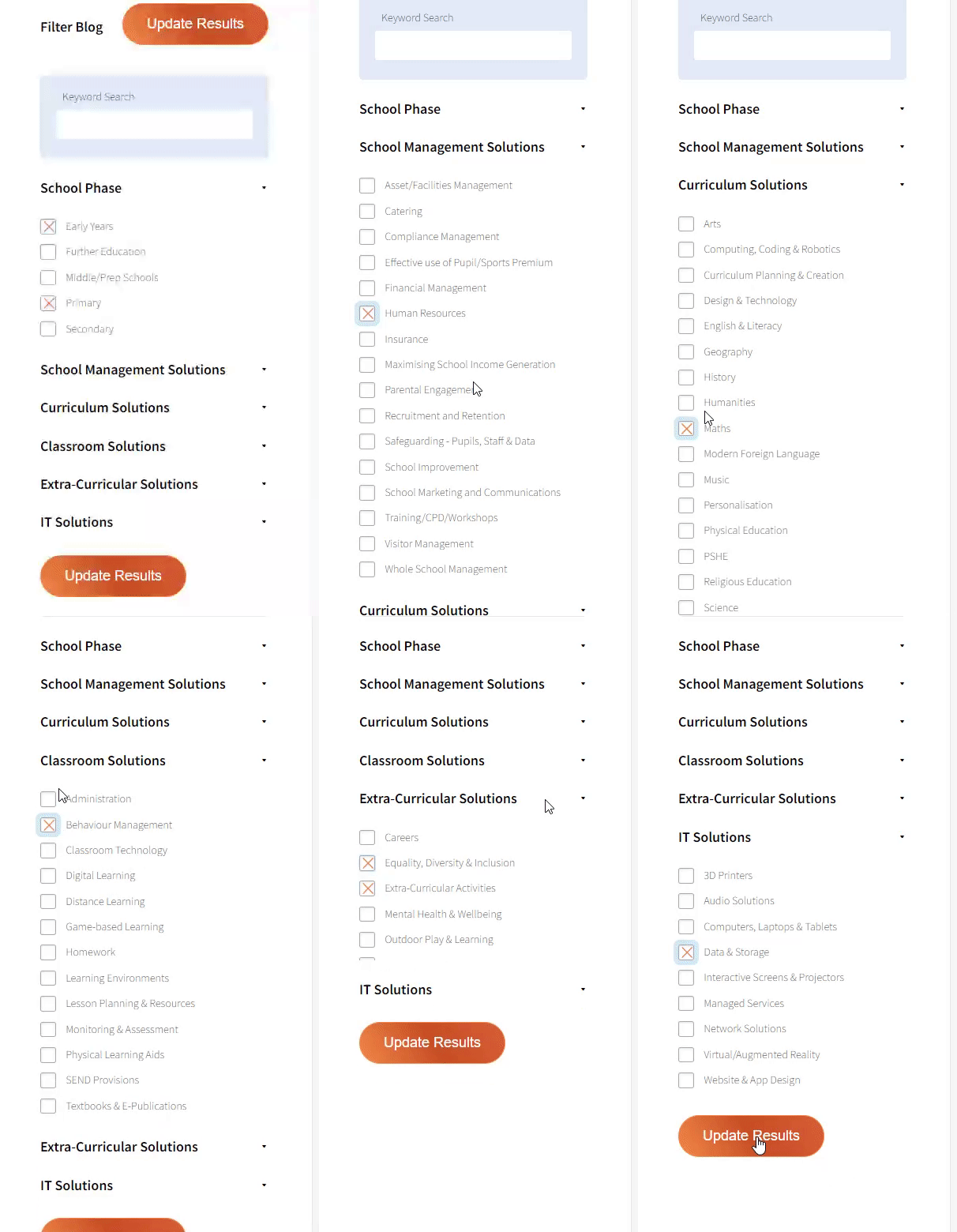
And there you have it! Now your collection of blogs are catered to your chosen topics and are ready for you to explore. Plus, if you frequently return to the same categories you can bookmark your current URL and we will save your choices on return. Happy Reading!
Great teaching is built on the power of storytelling and research shows that narrative- led instruction improves comprehension and information retention. But why is storytelling so powerful in the classroom and how can educators harness 3D technology to amplify its impact?
The Power of Narrative
Stories engage us because they provide context and meaning. When students encounter facts on their own they may struggle to understand. But when presented as part of a narrative, they can make a deeper connection.
Immersive storytelling strengthens this impact by placing learners inside a story. When students participate actively in their learning rather than simply receiving information, they experience emotion and build empathy. This in turn boosts comprehension, critical thinking and even retention. This is especially true in subjects such as history, literature and science where students benefit from adopting different viewpoints or seeing abstract ideas in context.
Augmented Reality Storytelling
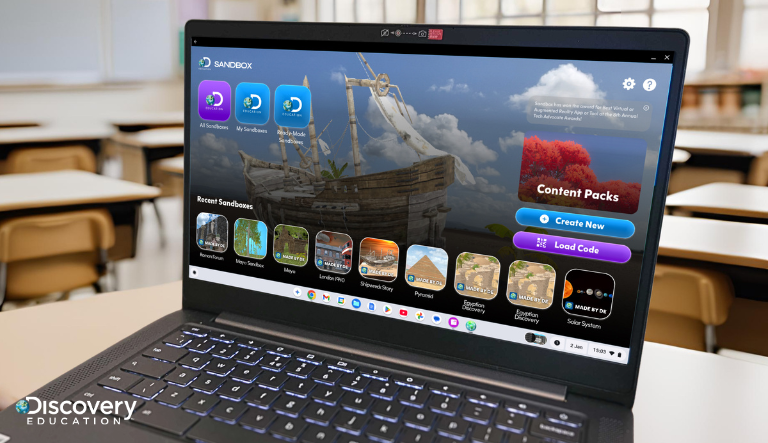
3D tools such as Discovery Education’s Augmented Reality (AR) app Sandbox transform narrative learning by allowing students to build and explore their own immersive worlds. Rather than passively reading about an event, they can recreate it. And instead of simply watching a video, they can make one themselves. This shift, from receiving information to actively creating it, turns students into powerful story makers.
Consider a lesson on Ancient Egyptian temple architecture. Traditionally, students might look at photos of Karnak or watch a short documentary. While helpful these materials lack a hands-on element. But what if students could design their own version of Ancient Egyptian, using AR?
They might begin building a temple, placing columns, sculptures and hieroglyphs based on their research. As they build, they’ll think about the story behind their creation. Who used this temple? Why was it important? What events or rituals happened here? Perhaps they’ll create a scene where a young Egyptian scribe attends a ceremonial celebration. In designing this moment they apply their knowledge of religion, history and art. These students aren’t just studying history, they’re stepping inside of it.
This is where AR truly shines. Using life-sized models, students can walk around their creations experiencing realistic scale and detail. This sensory engagement helps students to absorb not just the facts but the cultural significance.
Case Study: The Second World War
Lawford School in Essex provides a strong example of how this approach can transform learning. Students used Sandbox to explore World War II by building 3D models and crafting their own narratives.
Using a green-screen feature, they created news-style broadcasts interviewing virtual civilians and produced first-person videos showing what an air raid might have been like inside an Anderson Shelter. These student-built narratives allowed them to form emotional, personal connections to historical events, resulting in deeper understanding.
Teachers reported noticeable gains in engagement, teamwork, and critical thinking skills. The project demonstrated how 3D storytelling can turn history lessons into powerful, unforgettable experiences.
Education and Imagination
This method isn’t limited to history. Students can use 3D storytelling in AR to explore literature, model scientific processes, create virtual museums or build imaginative worlds for creative writing. The opportunities are nearly limitless, but the core idea remains the same. When students craft stories in 3D, they move from memorising content to truly understanding it.
By embracing tools like Discovery Education’s Sandbox, teachers can foster creativity, curiosity and critical thinking in ways that traditional teaching alone cannot. When students don’t just read about history but build it, and when they don’t just hear about different cultures but step into them, learning becomes an immersive experience. In the age of digital learning, 3D storytelling is the bridge between education and imagination, giving students the power to bring ideas to life.
Learn more about the entire suite of immersive learning solutions from Discovery Education here.







Are you looking for solutions? Let us help fund them! Nexus Education is a community of over 11,000 schools that come together to share best pract... View More
Established in 2011, One Education is a company at the heart of the education world, supporting over 600 schools and academies. Our unique appeal a... View More
School Space is a social enterprise that has empowered schools for over 14 years through their profitable and hassle-free lettings services. So far... View More
Unify is an online sales and marketing tool that allows users to create tailored personalised documents in moments. View More
There’s nothing special about the energy we sell. In fact, it’s exactly the same energy as all our competitors provide. But there is something spec... View More
Securus provide market-leading monitoring solutions to safeguard students on ALL devices both online and offline. We also offer a full monitoring s... View More
Robotical makes Marty the Robot - a walking, dancing coding robot that makes programming fun and engaging for learners as young as 5. Our robots co... View More