
18-09-2020
03:05
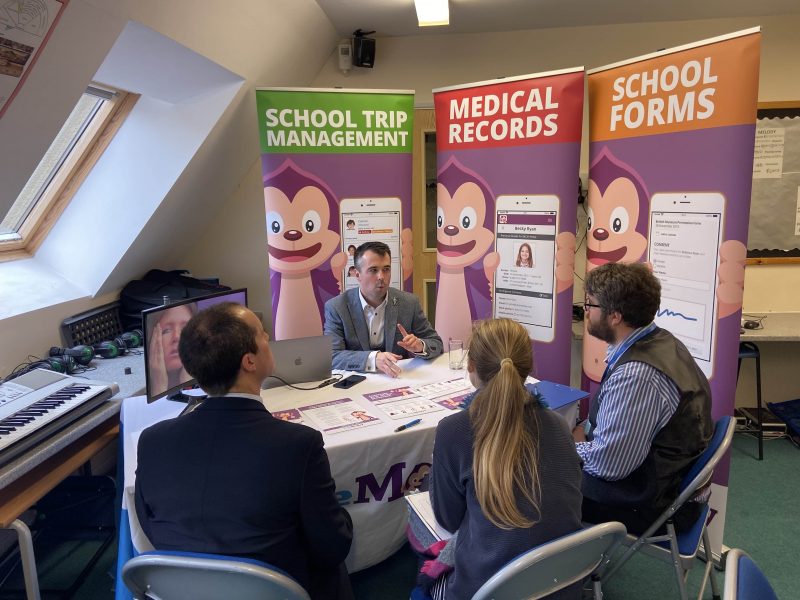
Our team sorts through all blog submissions to place them in the categories they fit the most - meaning it's never been simpler to gain advice and new knowledge for topics most important for you. This is why we have created this straight-forward guide to help you navigate our system.
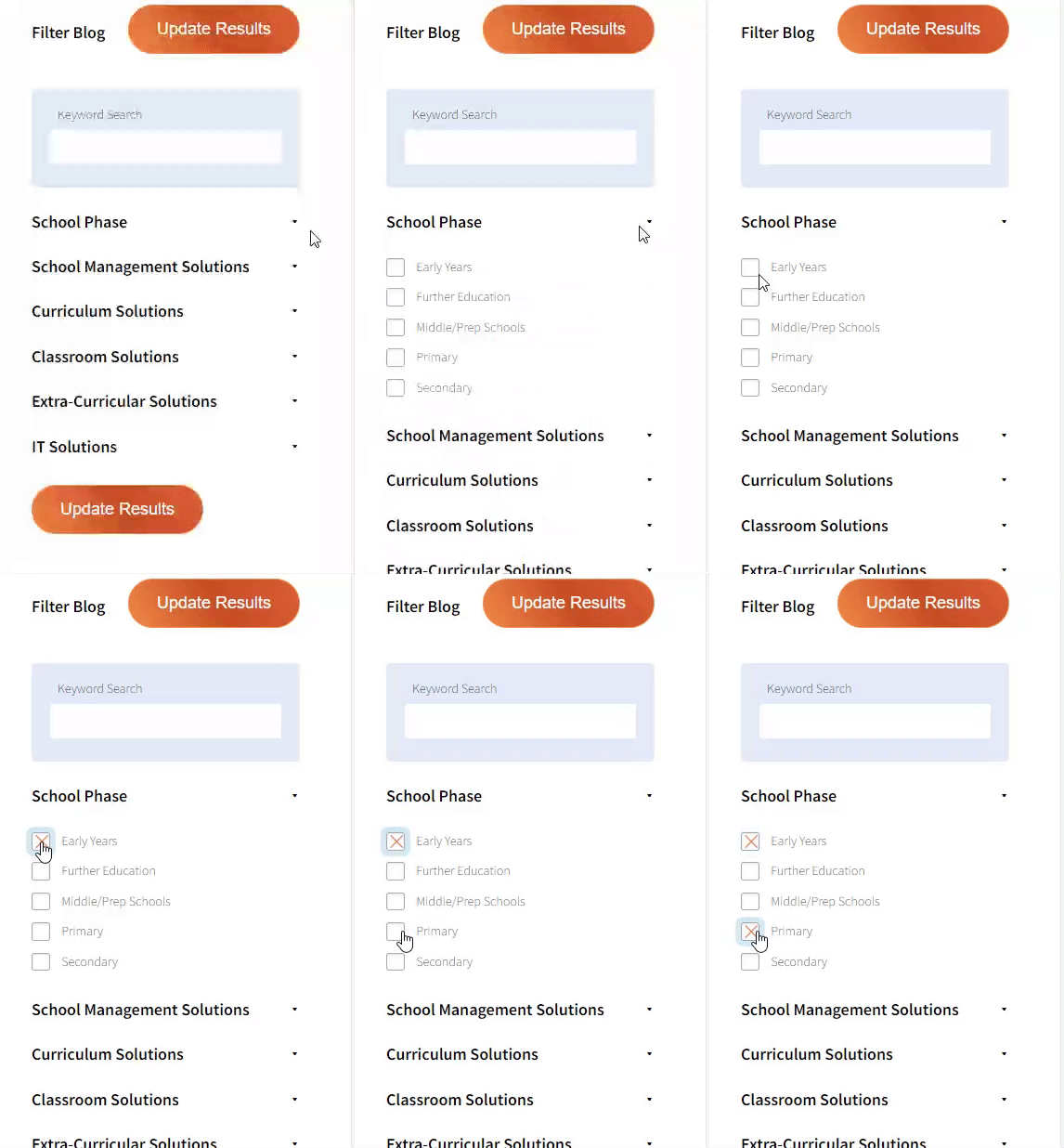
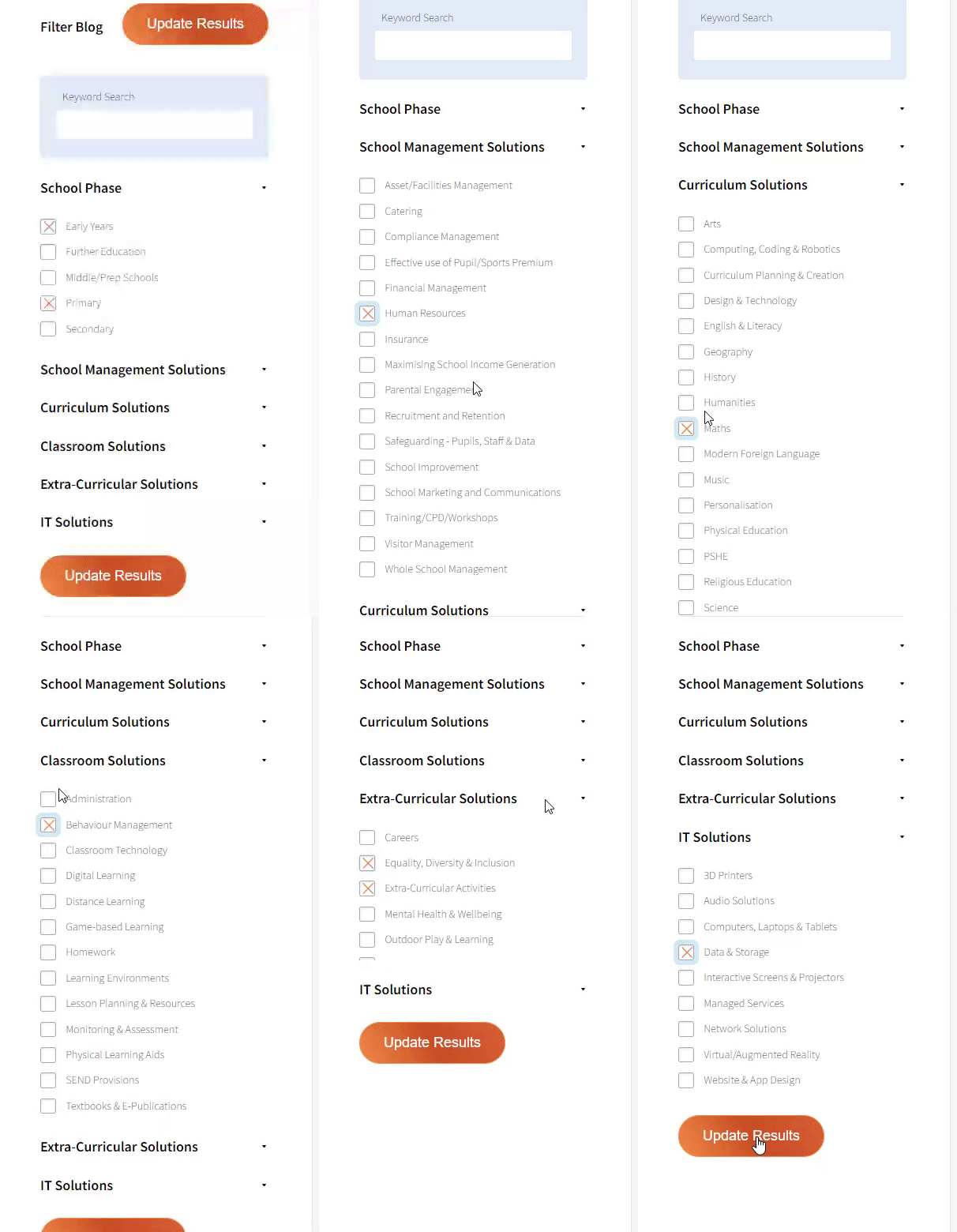
And there you have it! Now your collection of blogs are catered to your chosen topics and are ready for you to explore. Plus, if you frequently return to the same categories you can bookmark your current URL and we will save your choices on return. Happy Reading!
KCSIE 2026 is in force. The new academic year is underway. If you’re a school leader, you’ll know that September doesn’t gradually build pressure. Instead, it arrives. New staff. New pupils. New concerns. Old problems that didn’t disappear in July.
Suddenly, staffing decisions need attention, SEND pressures are back in focus, safeguarding concerns need careful consideration and strategic priorities collide with operational reality, decisions, SEND pressures. Safeguarding concerns. Parental expectations. Strategic priorities.
Everything needs attention. Yet, somehow, leaders are still expected to think clearly through all of it.

Part 1 of this series explored the emotional cost of leading. Part 2 asks a different question:
What happens to leadership when that weight has somewhere to go?
July exposes the emotional cost of leadership. By September, the operational cost becomes much more visible.
The urgency returns quickly. A staffing issue that looked manageable in July suddenly needs a decision, while a safeguarding concern requires careful consideration. At the same time, a SEND situation may become more complex and a strategic priority can collide with something that simply cannot wait.
None of this means leaders are failing.
Most leaders are exceptionally good at coping. However, the question is what happens when coping becomes the default way of leading.
When everything feels urgent, it becomes harder to distinguish noise from risk. It can also become harder to challenge an assumption, notice patterns or step back and ask whether the response is actually the right one.
That is why leadership capacity matters.
Between March and July, five education leaders took part in an Executive Leadership Supervision Pilot. The group met for 90 minutes once a month over five months. Participants came from different educational contexts, including primary, secondary, special and international education. Each participant brought a real leadership dilemma to the group. Rather than trying to solve it, the rest of the group explored the dilemma through questions, hypotheses and different perspectives.
The intention was simple: to think about the problem differently.
Baseline information was collected at the start, with midpoint and end-point evaluations alongside feedback from individual sessions. The findings are based on participant feedback from a small pilot, so they represent emerging evidence rather than proof of organisational impact.
Even so, something interesting emerged.
These weren’t leaders asking someone else to make decisions for them. At baseline, their average self-rating for leadership decision-making was 7.7 out of 10, while their average confidence in navigating complex or high-stakes safeguarding or organisational decisions was 7.3 out of 10.
In other words, they already had experience and professional judgement. What they were asking for was something different: space to think.
One participant described their hope for the pilot as:
“To have clearer thinking, to make more effective decisions.”
Another said:
“Space to be open, brave and reflect with others – I don’t need my problems solved.”
That distinction became important as the pilot developed.
Problems arrive and someone needs an answer. A decision needs making, a member of staff needs support or a safeguarding concern needs attention. As a result, the instinct to move quickly can be powerful. However, sometimes the most useful thing a leader can do is pause.
The supervision model deliberately created that pause. It included a No-Fixing/Advice-Giving principle, meaning participants were not expected to provide solutions to the dilemma being presented. Instead, they asked questions, explored hypotheses and offered different perspectives.
At the midpoint evaluation, respondents rated this approach 4.33 out of 5 for helping them think more deeply about a dilemma.
One participant captured the challenge perfectly:
“It’s hard to move beyond fixing!”
Exactly.
The aim isn’t to make leaders slower. Instead, it is to make the space between dilemma and response more intentional. Sometimes the most useful intervention isn’t another answer. It’s a better question.
By the end of the pilot, the language participants used was remarkably consistent.
They described giving themselves more time before responding, asking themselves better questions and considering different viewpoints. They also talked about seeking support rather than relying entirely on themselves, stepping back from the immediate situation and becoming less reactive and more proactive.
Importantly, several participants recognised that a decision does not always need to be made immediately.
One participant said:
“It has enabled me to step back and consider what questions I need to ask myself about a situation and consider how the group might challenge me.”
Another described becoming:
“more proactive rather than reactive in my decision making processes.”
And another described learning to:
“detach in a professional manner to see more clearly.”
These are self-reported experiences from a small pilot, so they should not be presented as proof that supervision causes improved leadership outcomes. Nevertheless, the consistency of the reflections is striking.
The pattern was: pause → question → perspective → reflection → decision.
Perhaps that is the real value of executive supervision in education. It isn’t about giving leaders better answers. It is about helping them ask better questions before they act.
One of the most interesting features of the pilot was that a participant’s dilemma did not belong only to the person who presented it. Everyone listened, thought and questioned. In turn, everyone had the opportunity to learn. At midpoint, participants shared examples of questions and hypotheses that had stayed with them beyond the session.
One asked:
“Who have I told what? When? And why?”
Another was left thinking about:
“What does sustainability look like at Woodlands?”
Another reflected on the fact that:
“we don’t always get the full picture.”
These questions travelled back into school. That matters because executive supervision isn’t simply about what happens during the 90-minute session. More importantly, it is about what leaders take back into their decision-making afterwards.
At the midpoint evaluation, respondents rated the supervision space 5 out of 5 for providing a safe environment to explore professional vulnerability. That matters because leadership can be lonely. However, the pilot revealed something more nuanced than simply saying supervision “reduces leadership loneliness”. It doesn’t make accountability disappear.
One participant reflected that although knowing others were facing similar challenges helped, the personal weight of responsibility remained. I think that’s important. Supervision doesn’t pretend that leadership is suddenly less difficult. Instead, it gives leaders somewhere to not carry it entirely alone.
One participant described it as:
“a safe space to open yourself to vulnerabilities that we, as leaders, are often afraid to do so.”
Another said:
“The one question asked by a peer can give more clarity and creates a new path for you.”
Sometimes that may be all a leader needs. Not another answer. Another perspective.
Perhaps the most powerful feedback from the pilot was not about the individual leader at all. It was about what began to happen when participants took the experience back to their own teams.
At midpoint, one leader described becoming:
“more thoughtful in the supervision sessions / conversations I have with my team where I am encouraging them to be more curious and not simply focus on solutions.”
Another said they had begun to:
“think more about how they might work through problems rather than trying to fix!”
And at the end of the pilot, one participant described the effect this way:
“By changing my own approach, this has had a trickle-down effect on the team I lead.”
This is where the idea of the parallel process becomes interesting.
When leaders experience being listened to without judgement, they experience something they may then choose to create for others. Similarly, when leaders experience challenge without being given an answer, they may become more comfortable allowing their own staff to think rather than immediately solving the problem for them.
In the same way, when leaders experience reflective space, they begin to understand what it feels like to have it.
This is not evidence that the pilot changed organisational culture. It was too small and too short to establish that. There were, however, early signs that something was beginning to move beyond the individual leader. And that is worth paying attention to.
Quite a lot. But perhaps not in the way we first assume.
Executive supervision in education is not a statutory safeguarding requirement. It does not replace safeguarding supervision, DSL processes, governance oversight, professional advice or statutory procedures.
Its purpose is different. It creates protected space for leaders to examine the thinking behind complex decisions. That distinction matters.
KCSIE 2026 is now the statutory safeguarding framework that schools and colleges are working within. It sets out the legal duties schools and colleges must follow to safeguard and promote the welfare of children and young people.
At the same time, the wider safeguarding system is placing emphasis on the quality of professional thinking. The 2026 Working Together to Safeguard Children guidance highlights constructive debate and analysis, active constructive challenge and independent judgement. It also says that independent judgements should be given space alongside collective decision-making to help avoid groupthink.
These aren’t arguments that leaders should simply slow everything down. Instead, they are reminders that good safeguarding leadership requires more than knowing the procedure.
It requires leaders who can:
Executive supervision can provide one structured environment in which those habits can be developed and practised.
Not as another layer of compliance.
As leadership infrastructure.
One participant described the experience as:
“a preventative learning opportunity.”
I think that is an important distinction. Support is often sought when something has already gone wrong. A difficult decision has landed, a safeguarding concern has escalated, a relationship has become strained or a leader feels stuck. Group executive supervision creates another possibility. Leaders can learn from dilemmas they have not personally experienced. They hear questions they might not have thought to ask and encounter perspectives they might not have considered.
As a result, they develop a repertoire of questions and ways of thinking that they can take into future situations. In that sense, supervision is not simply somewhere to take today’s problem. It can help prepare leaders for tomorrow’s complexity.
There is a temptation to see reflective space as something leaders can have once everything else has been dealt with. but everything else is rarely dealt with. There will always be another email, another safeguarding concern, another difficult conversation or another staffing problem. Then there is another parent complaint and another strategic decision waiting behind it. If thinking space is always postponed until the urgent work is finished, it may never happen.
So perhaps this isn’t really a question about whether leaders can cope. Most will. They always do. The more important question is: What does constant coping cost?
What happens to decision quality when leaders are permanently operating at the edge of their capacity?
What happens to professional curiosity when there is no time to step back?
What happens when the instinct to fix becomes stronger than the instinct to understand?
And what happens to the people we lead when urgency becomes the culture we model?
These are not arguments for reducing accountability. Instead, they are arguments for strengthening the conditions in which accountability can be exercised well.
It needs leaders with space to think. Executive supervision in education will not remove complexity. It will not eliminate risk, and it will not stop the next dilemma landing on a leader’s desk. And it shouldn’t.
Leadership is complex. Safeguarding is complex. Schools are complex.
The question is whether leaders have somewhere to pause long enough to make sense of that complexity.
Part 1 of this series explored the emotional weight leaders carry. This part has explored what can happen when they have somewhere to put it. The pilot suggests a potentially important shift:
from fixing to thinking.
from reacting to reflecting.
from carrying alone to thinking with others.
from needing the answer to asking a better question.
KCSIE 2026 is now part of the landscape leaders are working within. The challenge is not simply understanding the expectations. It is having the capacity to meet them thoughtfully when the reality in front of them is complicated.
So perhaps the question this September is no longer: “Can our leaders cope?” Perhaps it is: “Have we created the conditions in which our leaders can think well enough to lead safely?”
Leaders don’t need space to think because they are failing. They need it because the work matters too much for them not to.
Five leaders. Five months. One 90-minute group session each month.
The pilot brought together leaders from different educational contexts, including special and international education. Each participant brought a real leadership dilemma for the group to explore through questions, hypotheses and different perspectives.
Baseline information was collected at the start, with midpoint and end-point evaluations and session feedback gathered throughout the pilot. Response numbers varied across the evaluation points.
The findings presented here are participant-reported and represent emerging evidence from a small pilot rather than a controlled evaluation.
5 leaders participated
5 months of group supervision
90 minutes per monthly session
5 baseline questionnaire responses
4 end-point evaluation responses
5/5: midpoint rating for safety to explore professional vulnerability
4.67/5: midpoint rating for the 90-minute structure supporting a slowing of leadership pace
4.33/5: midpoint rating for the No-Fixing/Advice-Giving approach supporting deeper thinking
4/4: end-point respondents would recommend reflective supervision to other senior leaders





Are you looking for solutions? Let us help fund them! Nexus Education is a community of over 11,000 schools that come together to share best pract... View More
Established in 2011, One Education is a company at the heart of the education world, supporting over 600 schools and academies. Our unique appeal a... View More
School Space is a social enterprise that has empowered schools for over 14 years through their profitable and hassle-free lettings services. So far... View More
Unify is an online sales and marketing tool that allows users to create tailored personalised documents in moments. View More
There’s nothing special about the energy we sell. In fact, it’s exactly the same energy as all our competitors provide. But there is something spec... View More
Securus provide market-leading monitoring solutions to safeguard students on ALL devices both online and offline. We also offer a full monitoring s... View More
Robotical makes Marty the Robot - a walking, dancing coding robot that makes programming fun and engaging for learners as young as 5. Our robots co... View More