
11-04-2019
06:48
Our team sorts through all blog submissions to place them in the categories they fit the most - meaning it's never been simpler to gain advice and new knowledge for topics most important for you. This is why we have created this straight-forward guide to help you navigate our system.
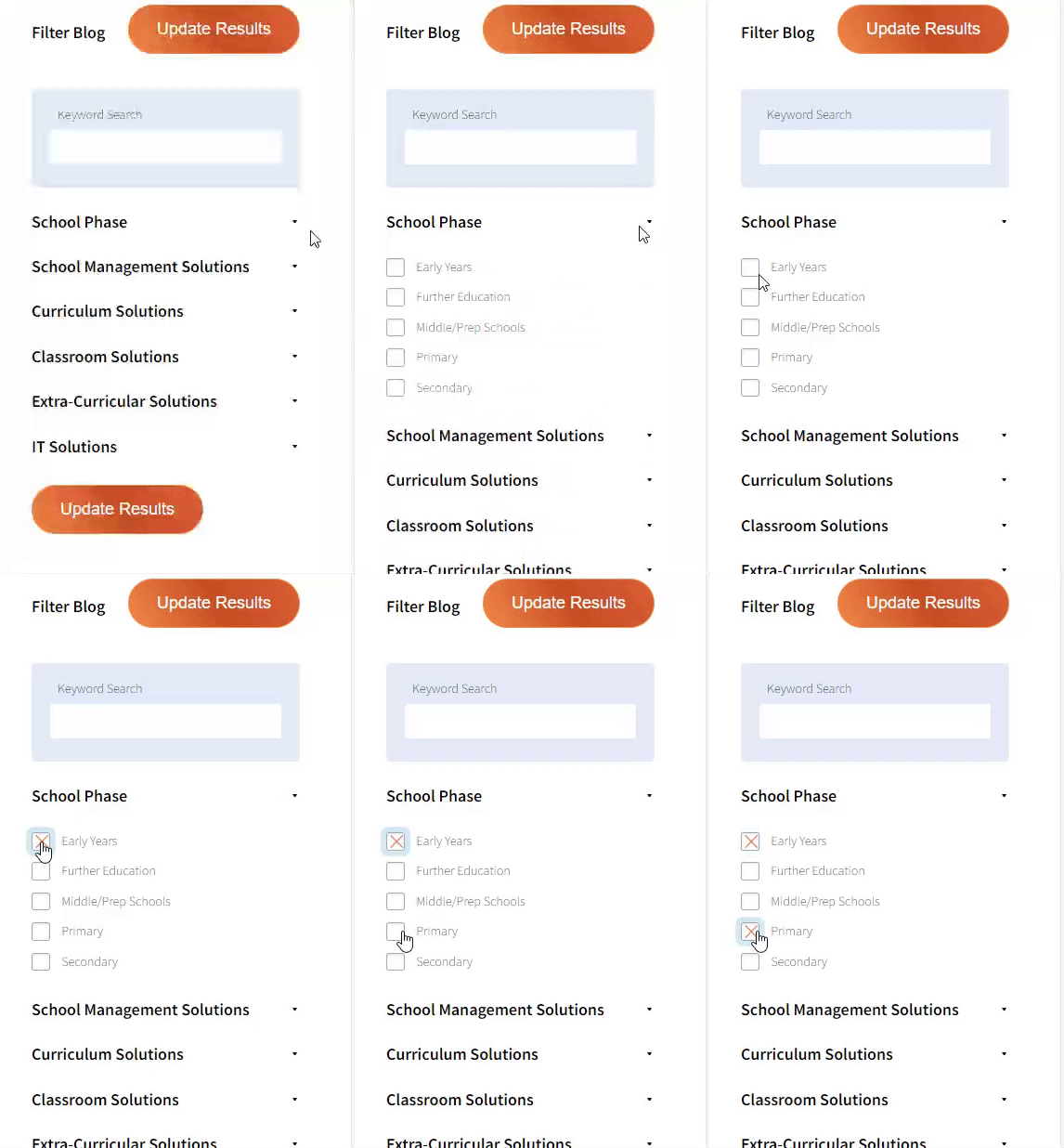
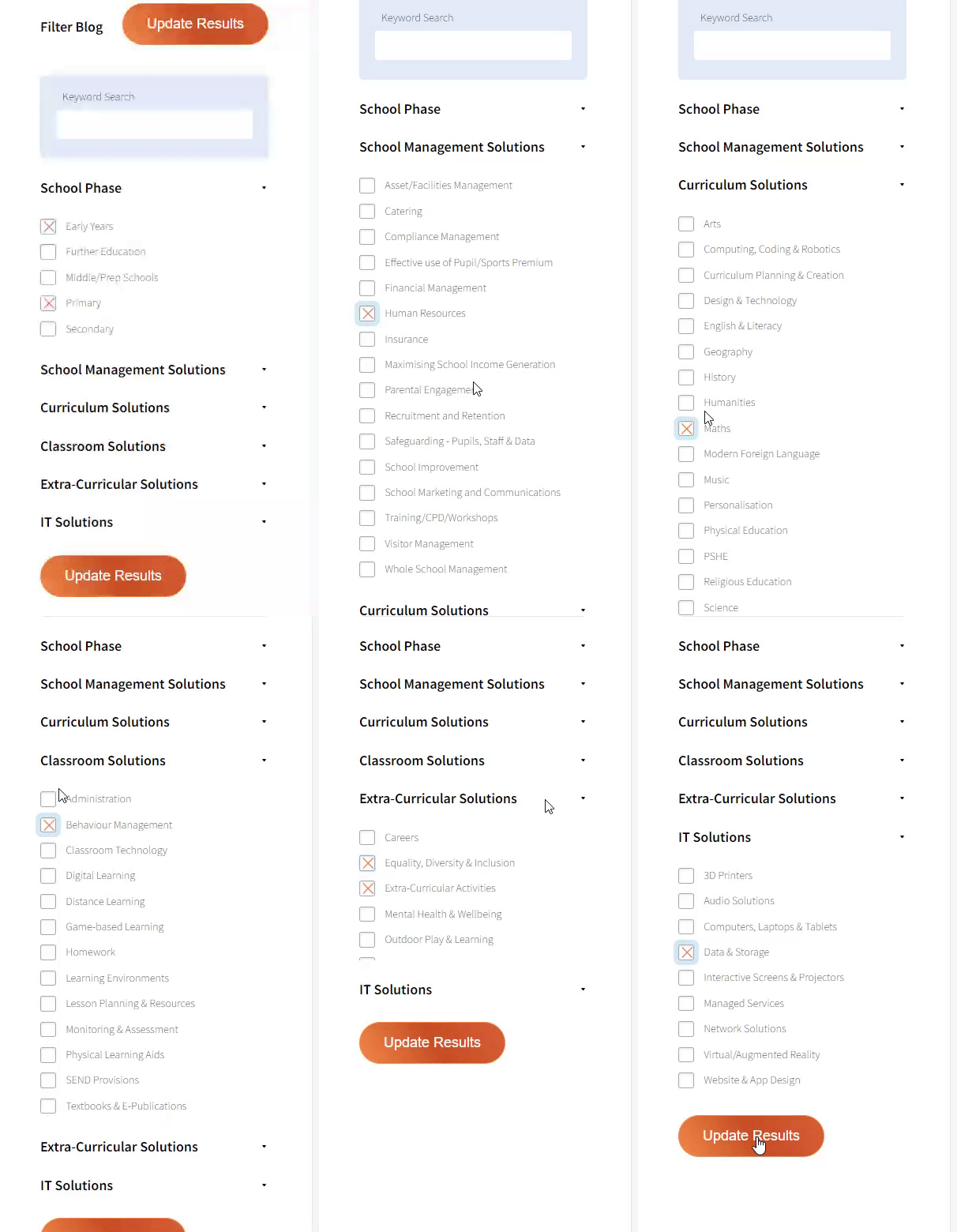
And there you have it! Now your collection of blogs are catered to your chosen topics and are ready for you to explore. Plus, if you frequently return to the same categories you can bookmark your current URL and we will save your choices on return. Happy Reading!

“Because I said so”.
These words resonate with parents throughout the land. They are the words we all try to avoid but inevitably cling to when all else fails. They imply a paucity of argument but a certainty of action. They are used when all else has failed or merely to emphasise the superiority of position of the part delivering these words, which leads us on to the recent decision to ban smartphones in British schools. The decision that “All schools should be mobile phone-free environments by default” (DfE 2026) is to be given legal standings means that in effect, under 16s will not have access to phones in schools. Our argument is that this move is a retrograde step driven by a lack of understanding of digital literacy and a moral panic, driven by a generation for whom the smartphone is still something to be wary of, rather than something to embrace.
Collectively we represent the Xennial (1977-1983) and Gen X (1965-1976) generations, having experienced technology free childhoods, early email communication and dial up browsers. Experiencing the migration of using the internet as a new form of communication and mild entertainment to the rise of social media with its instant messaging and later, the smartphone, offering instantaneous communication on the go. The transition though a vastly changing technological society meant that we were learning ‘on the go’, experimenting with amazingly convenient and new modes of contact with other all over the world without having much opportunity to pause for breath, or to question the implications of online activity. And who was there to ask? Teachers and parents, the elders we would traditionally look to for guidance were very quickly becoming outdated in their knowledge, in this, Xennial’s and Gen X’s were completely alone, navigating the world of possibility through clunky PC’s which evolved into a handheld utopia in the blink of an eye. If we said that we could look back and say that all our online activity was sensible, even safe, we would be lying. This unguided exploration into a new world lingers, permeates thoughts and inevitably colours views of the digital environment.
What we have now is the opportunity, as elders ourselves, to guide our young in the use of the internet as well as allowing them the freedom to experience it how they wish, to help them move from being digitally competent (in that they know how to use the technology) to being digitally literate (they understand what they are doing). This jump needs to happen in order for them to avoid the mistakes we made, so surely school is the ideal place for this to occur? We have the chance to set the parameters of what is socially acceptable and what is unhealthy. We can help avoid screen addiction, risky online activity and a potential decline in real life social interactions and pursuits if we allow smartphones to be part of the natural fabric of society, not to be held up as a portal of doom, something that is against the principles of education. In addition, we need to embrace the fact that smartphones can bring so much to the classroom, text translation, research criticality and instantaneous syntheses of information can all aid learning and help children see that they can be a force for good.
Outside of school we are encouraged from a young age to use smartphones to assist their day-to-day life, from booking cinema trips, listening to music and most importantly, researching. The guidance talks about how there can be allowances for some children (“by exception only”) but again this indicates woolly thinking rather than carefully crafted thought. Does this mean that it is acceptable for a dyslexic student to use their phone for dictating notes? That an autistic student may use their phone for music or vibration? Do these things not benefit lots of people from time to time?
A blanket ban fails to see the many nuances in learning and how each person’s relationship with technology is different and hence a heterogeneric issue is decided by a homogenous decision. What is the common theme is the importance of supporting with boundaries and making sure children understand the difference between being digitally competent, in that they can operate the technology and digitally literate, where they can use what they find safely and productively. Yes, we would support setting boundaries and expectations within the school environment and should be something that is considered very carefully by the school / governing body of an establishment but that should undoubtedly include voices from the student body and not be dictated by central legislation, brought to Parliament by generations for whom digital technology is still seen as new.
So our call to those with influence is to embrace technology in schools and use it as a force for good. We should promote democracy, fairness and inclusion within our younger generations, rather than imposing blanket sanctions without consideration of a compromise. If not we risk villainising smartphones and pushing internet use into the recesses of society, marking it as a barrier to learning and indeed personhood. So instead of saying ‘because I said so’, we should use another quote ‘Our lives are defined by opportunities’ (Button 2008).
Smartphones are an opportunity.
Department for Education (2026) Mobile Phones in Schools, available at: https://www.gov.uk/government/publications/mobile-phones-in-schools/mobile-phones-in-schools
Roth, E. (2008) The Curious Case of Benjamin Button Screenplay, New York: Scribner.







Are you looking for solutions? Let us help fund them! Nexus Education is a community of over 11,000 schools that come together to share best pract... View More
Established in 2011, One Education is a company at the heart of the education world, supporting over 600 schools and academies. Our unique appeal a... View More
School Space is a social enterprise that has empowered schools for over 14 years through their profitable and hassle-free lettings services. So far... View More
Unify is an online sales and marketing tool that allows users to create tailored personalised documents in moments. View More
There’s nothing special about the energy we sell. In fact, it’s exactly the same energy as all our competitors provide. But there is something spec... View More
Securus provide market-leading monitoring solutions to safeguard students on ALL devices both online and offline. We also offer a full monitoring s... View More
Robotical makes Marty the Robot - a walking, dancing coding robot that makes programming fun and engaging for learners as young as 5. Our robots co... View More