
13-03-2020
10:55
Our team sorts through all blog submissions to place them in the categories they fit the most - meaning it's never been simpler to gain advice and new knowledge for topics most important for you. This is why we have created this straight-forward guide to help you navigate our system.
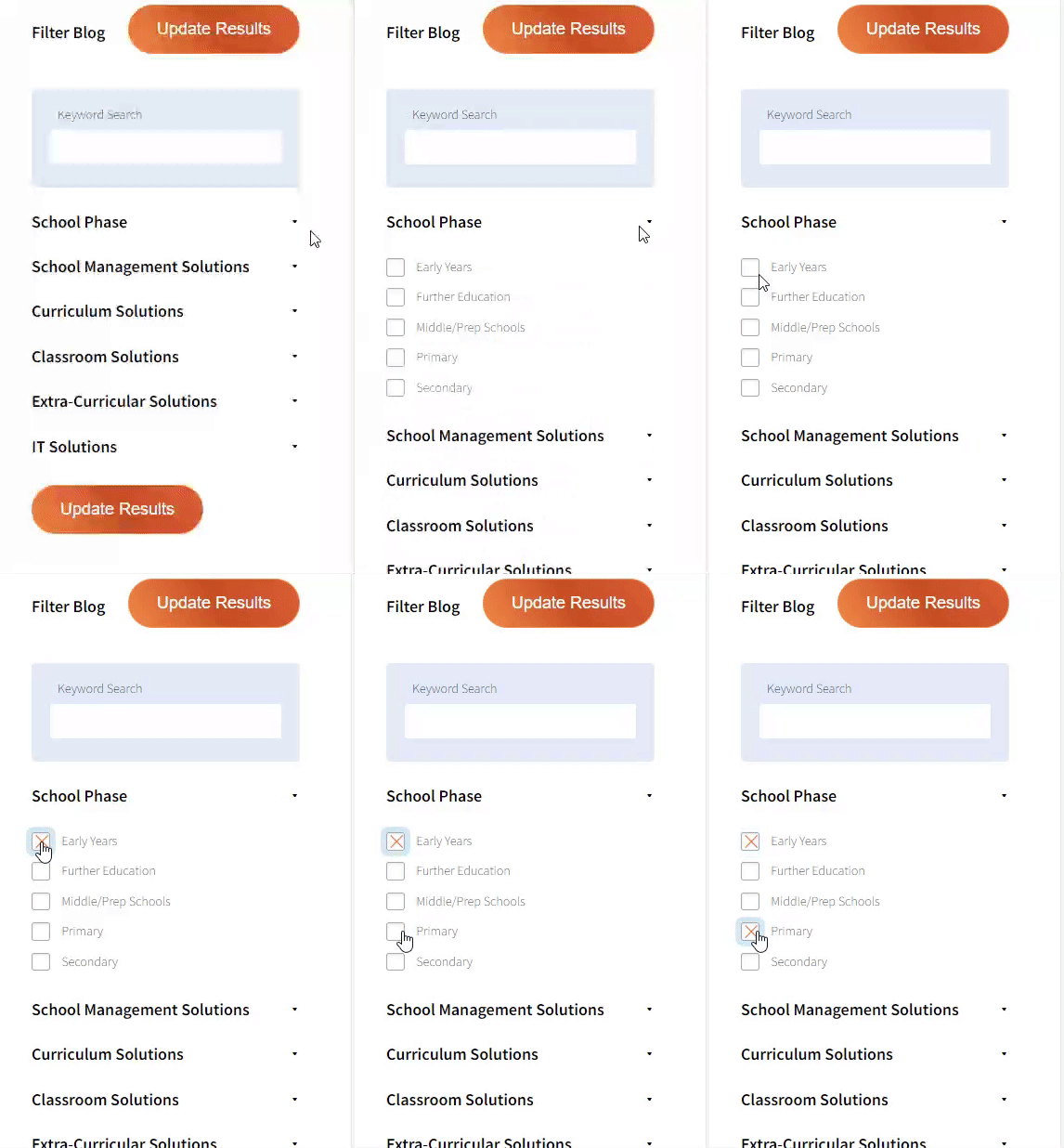
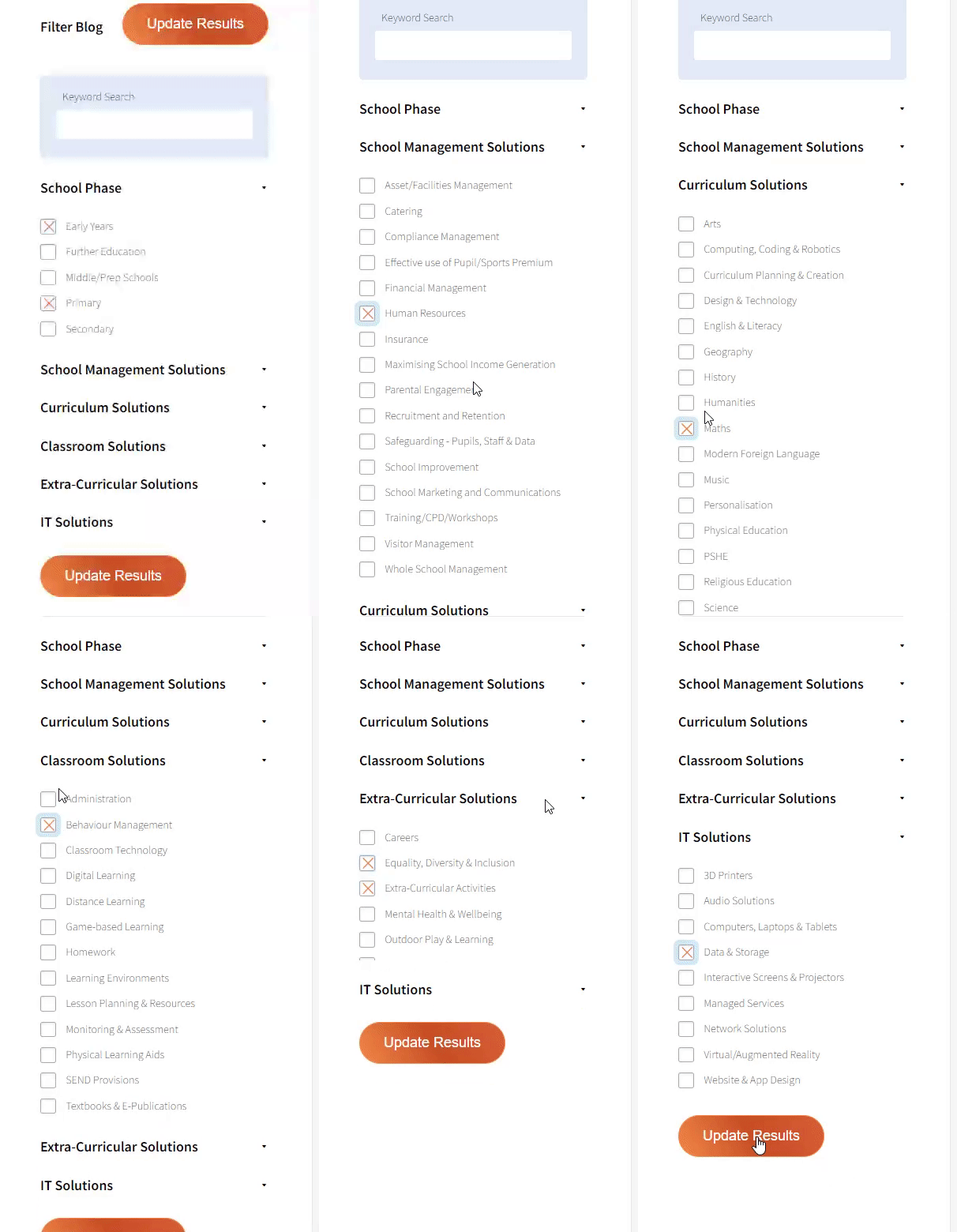
And there you have it! Now your collection of blogs are catered to your chosen topics and are ready for you to explore. Plus, if you frequently return to the same categories you can bookmark your current URL and we will save your choices on return. Happy Reading!
Authors
This innovative project has ten team members, and uses a co-researchers model with four students as researchers.
The team is composed of:
Anna Judd-Yelland (PI)
Dr Paula Addison-Pettit
Mel Green
Dr Carlos Montoro
Catherine Carden
Dr Poppy Gibson
Eunice Acheampomaa (student co-researcher)
Joanne Sandhu (student co-researcher)
Ricky O’Connor (student co-researcher)
Catherine Newport (student co-researcher)
Introduction
Have you heard of ‘Listening Rooms’?
The Listening Rooms methodology (Parkin and Heron, 2022) is a qualitative research approach, especially in higher education, where friends have recorded conversations about their lived experiences using researcher-designed prompts, capturing authentic, peer-to-peer insights on themes like belonging or success. These conversations are recorded and transcribed by the researchers, using thematic analysis to draw out themes. One strength of this method is that we can see how Listening Rooms offer the opportunity to reveal true participant voices outside power dynamics such as in a 1:1 interview between researcher and participant. Listening Rooms focus on generating rich data by creating a safe, private space for deep, personal sharing, often revealing nuanced perspectives on challenges like student support or diversity.

The Hidden Curriculum
Why is capturing these conversations important? The hidden curriculum of assessment and uneven levels of assessment preparation and support has been found to most impact racially minoritised students. Nguyen, Rienties and Richardson (2019) analysed the learning analytics of students based on their digital traces in naturalistic distance learning settings, they found that Black and Minority Ethnic (BME) students were 19-79% less likely to complete, pass or gain an excellent grade in comparison to white students despite spending 4-12% more time studying. Uneven levels of or a total lack of assessment support and preparation, when accompanied by different modes of assessment, often left racially marginalised students unprepared.
Exploring students’ experiences of racially inclusive assessment practices in online distance learning.
This project, funded by The Open University Praxis Scholarship Centre, explores how elements of Campbell and Duke’s (2023) racially inclusive assessment framework (RIPIAG) can be adapted for an online distance learning context. The framework has been designed to address the hidden curriculum of assessment and uneven levels of assessment preparation and support that was found to most impact racially minoritised students.
A team of ten researchers at the Open University are currently using the Listening Rooms methodology for their project exploring students’ experiences of racially inclusive assessment practices in online distance learning. The team have invited students to take part in Listening Rooms, speaking to prompts on the topics of ‘success’, ‘belonging’, ‘journey’ and ‘confidence’.
Listening Rooms originated at Sheffield Hallam as a face-to-face method, but successfully shifted to an online format always capturing conversations between peers with established relationships (Parkin and Heron, 2022). In this OU study, the distance learning participants are first introduced to each in the online Listening Room.
Alongside the Listening Rooms, student surveys and assessment support tutorials are taking place, as well as quantitative data collection from the student data dashboard. Data collection and analysis is still ongoing, but the findings from this study will offer valuable insight into ways educators can better provide education that is racially inclusive.
So, what is the takeaway?
We all know that listening to students’ voices is key. The Listening Rooms methodology is one way we can aim to capture the most authentic voices when conducting research in education. If you are planning a research project, why not consider if this could be a suitable method for you?
References
Campbell, P., & Duke, B. (2023). An Evaluation of the Racially Inclusive Practice in Assessment Guidance Intervention on Students’ and Staffs’ Experiences of Assessment in HE: A Multi-University Case Study (Version 1). University of Leicester. https://doi.org/10.25392/leicester.data.23579565.v1 (Accessed: 21 January 2026).
Nguyen, Q., Rienties, B. & Richardson, J.T. (2020) Learning analytics to uncover inequality in behavioural engagement and academic attainment in a distance learning setting. Assessment & Evaluation in Higher Education, 45(4), pp. 594-606.
Parkin, H. and Heron, E. (2022) Innovative methods for positive institutional change: The Listening Rooms Project and student and staff ‘voice’. Educational Developments, 23 (3), 13-17.






Are you looking for solutions? Let us help fund them! Nexus Education is a community of over 11,000 schools that come together to share best pract... View More
Established in 2011, One Education is a company at the heart of the education world, supporting over 600 schools and academies. Our unique appeal a... View More
School Space is a social enterprise that has empowered schools for over 14 years through their profitable and hassle-free lettings services. So far... View More
Unify is an online sales and marketing tool that allows users to create tailored personalised documents in moments. View More
There’s nothing special about the energy we sell. In fact, it’s exactly the same energy as all our competitors provide. But there is something spec... View More
Securus provide market-leading monitoring solutions to safeguard students on ALL devices both online and offline. We also offer a full monitoring s... View More
Robotical makes Marty the Robot - a walking, dancing coding robot that makes programming fun and engaging for learners as young as 5. Our robots co... View More