15-07-2026
11:01
Our team sorts through all blog submissions to place them in the categories they fit the most - meaning it's never been simpler to gain advice and new knowledge for topics most important for you. This is why we have created this straight-forward guide to help you navigate our system.
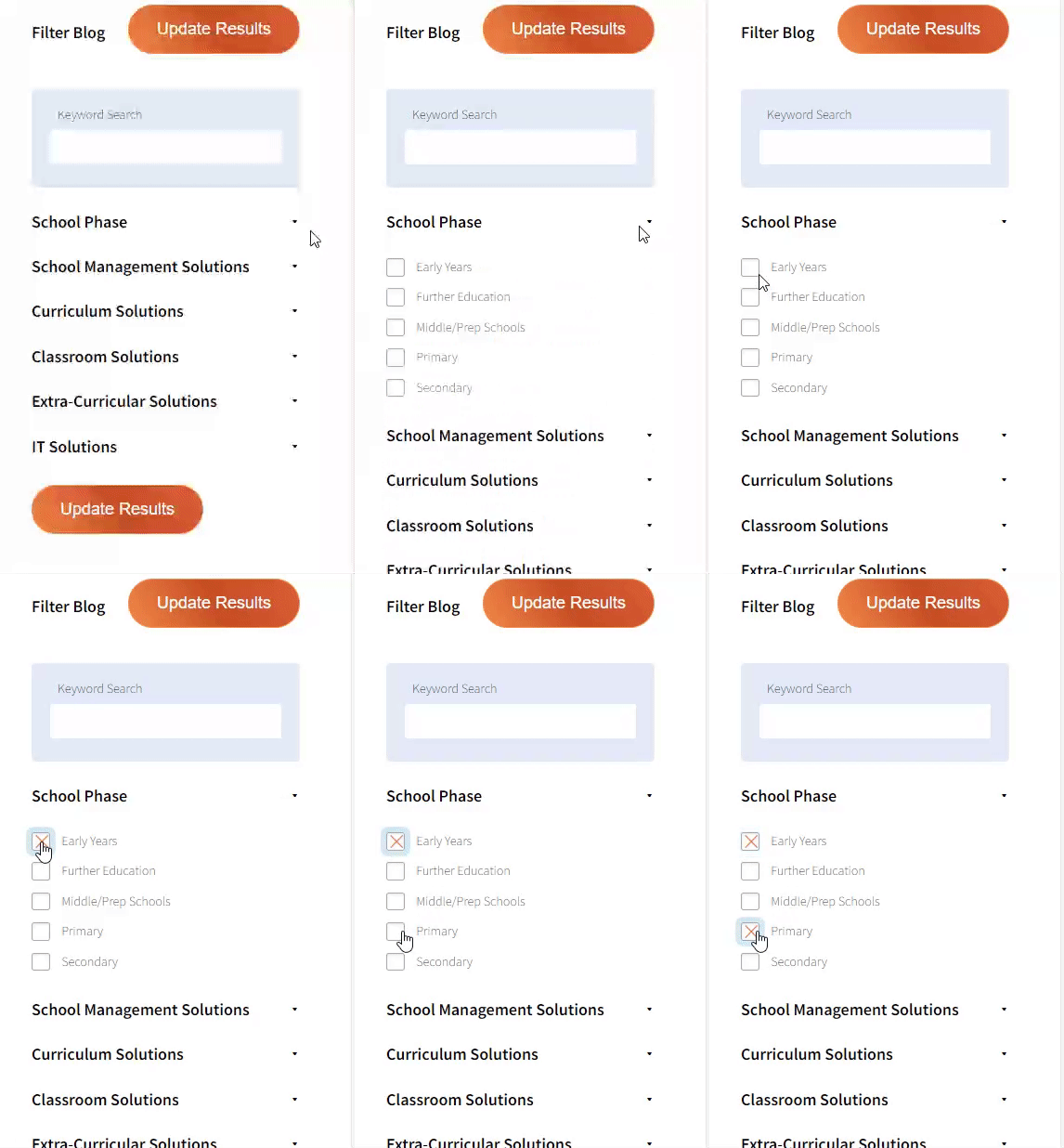
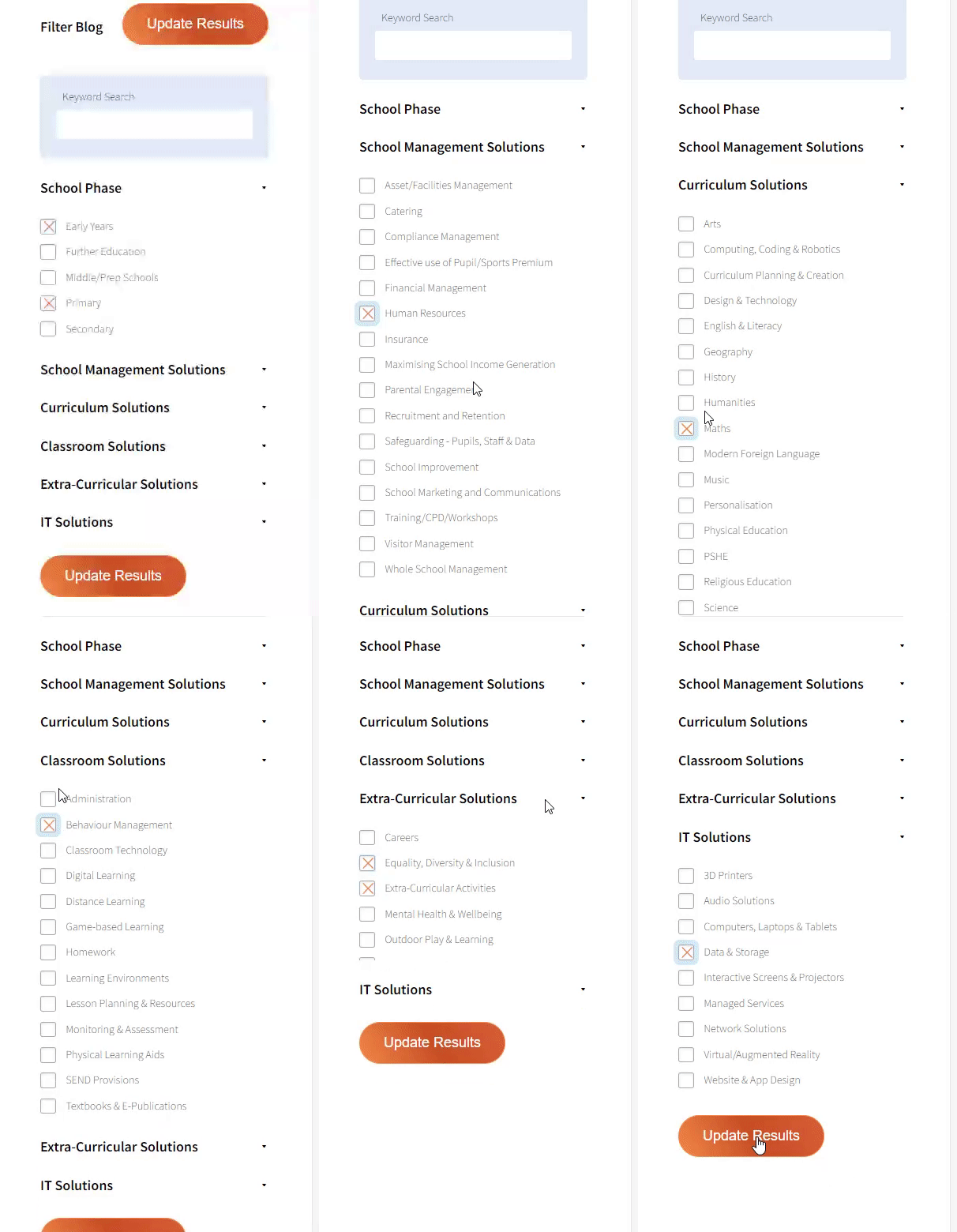
And there you have it! Now your collection of blogs are catered to your chosen topics and are ready for you to explore. Plus, if you frequently return to the same categories you can bookmark your current URL and we will save your choices on return. Happy Reading!
Things have been changing in the classroom and over time it has become more noticeable. As a lecturer I find myself noticing it in small ways. The quick check of a phone, the sense that sitting is harder to maintain, the times where attention drifts sooner than expected. At the same time I see students who are insightful, engaged and capable of really thoughtful discussion. Therefore, this isn’t about students being less able to learn, It feels more like learning is taking place within a very different context.
Students are immersed in fast, responsive and highly engaging digital spaces. Platforms such as TikTok, Instagram and YouTube deliver content in short, visually stimulating bursts, often tailored to individual preferences and updated constantly. Alongside this, there is a steady stream of notifications and messages competing for attention. Higher education asks for something else entirely. It requires time, patience and the ability to consider ideas long enough to make sense of them. Rather than framing this as a problem, I wonder if we think of this as something we need to understand more carefully.
Attention develops through experience. What we repeatedly do shapes what feels natural. Studies exploring media multitasking and device use point towards an impact on working memory and depth of processing, particularly when attention is divided (Ophir et al., 2009; Junco and Cotten, 2012). There is also evidence that simply having a mobile phone nearby can reduce the mental capacity available for demanding tasks (Ward et al., 2017). This doesn’t mean students are unable to concentrate. It suggests that attention is often spread across multiple inputs, rather than directed in one place for a sustained period.
In higher education, we are asking students to focus in ways that may not always match how they are used to engaging with information. That shift takes effort and it is not always explicitly supported. Cognitive load theory offers a helpful way of thinking about this. Learning relies on having enough mental space to process and connect information (Sweller, 1988). When attention is interrupted, that space becomes more difficult to maintain. What we are seeing, then, may be less about disengagement and more about competing demands on attention.
Bringing in a sensory and occupational perspective adds another dimension. Attention is closely linked to regulation. How alert, settled or overwhelmed someone feels will shape how they engage. Many of the environments students move through are high in stimulation, constant movement, sound, visual input and interaction. Entering a classroom, where the pace is slower and the sensory input reduced, can feel like a significant change. For some students, this supports focus. For others, it can make it harder to stay alert. This might show up as fidgeting, restlessness or a tendency to check devices. Seen in this light, some of the behaviours that appear as distraction may also be attempts to maintain an optimal level of alertness.
This connects with the Yerkes–Dodson law, which highlights that both low and high levels of stimulation can affect performance. Finding the right level of engagement is not always straightforward and it will vary between individuals. There are also clear links with work around sensory processing, particularly for neurodivergent learners, where differences in sensory experience can shape how environments are navigated (Ashburner et al., 2008). At the same time, this is relevant across the student population.
Looking at my own teaching, I can see patterns emerging. Engagement tends to be strongest during discussion, application and activities that connect learning to practice contexts. In contrast, longer periods of input can be harder to sustain, even when the content is well structured. Also, clarity has made a noticeable difference. When students understand what they are doing, how it links to their assessment and why it matters, they are more likely to stay with the task. Breaking sessions into shorter sections and varying the pace also seems to support engagement. However, what has shifted most for me is how I interpret what I see. Phone checking or restlessness no longer immediately reads as lack of interest. That perspective has encouraged me to adjust my approach alongside my expectations of students.
There is a pull towards making teaching faster, more dynamic and more visually stimulating in response to the wider digital environment. I’m not convinced that simply increasing pace is the answer. Higher education offers something different and that difference matters. For example, it provides space for deeper thinking, for grappling with complexity and for developing sustained attention. At the same time, teaching does not sit outside of the world students are part of.
A more considered approach might involve:
There is also value in making this visible. Talking openly about focus and distraction can help students to reflect on their own approaches to learning. This aligns with a constructive alignment approach, where teaching, learning activities and assessment are clearly connected to support student learning (Biggs and Tang, 2011).
It would be easy to describe this as a reduction in attention, but that feels too simplistic.
What is becoming visible is a change in how attention is shaped and experienced.
For higher education, this creates an opportunity to think more carefully about teaching. To consider how learning is designed, how behaviour is interpreted and how students are supported to engage.
Rather than trying to mirror the pace of digital environments, there is value in offering something different. A space where thinking can take time, where ideas can be explored fully and where attention can be developed with intention, which to me feels less like a problem to solve and more like a direction to grow into…. maybe?
Connect with me on LinkedIn.
Interested in finding out more about sensory processing? Read my books here.
Please find another written piece here
Ashburner, J., Ziviani, J. and Rodger, S. (2008) ‘Sensory processing and classroom emotional, behavioural, and educational outcomes in children with autism spectrum disorder’, American Journal of Occupational Therapy, 62(5), pp. 564–573.
Biggs, J. and Tang, C. (2011) Teaching for quality learning at university. 4th edn. Maidenhead: Open University Press.
Junco, R. and Cotten, S.R. (2012) ‘No A 4 U: The relationship between multitasking and academic performance’, Computers & Education, 59(2), pp. 505–514.
Ophir, E., Nass, C. and Wagner, A.D. (2009) ‘Cognitive control in media multitaskers’, Proceedings of the National Academy of Sciences, 106(37), pp. 15583–15587.
Sweller, J. (1988) ‘Cognitive load during problem solving: Effects on learning’, Cognitive Science, 12(2), pp. 257–285.
Ward, A.F., Duke, K., Gneezy, A. and Bos, M.W. (2017) ‘Brain drain: The mere presence of one’s own smartphone reduces available cognitive capacity’, Journal of the Association for Consumer Research, 2(2), pp. 140–154.





Are you looking for solutions? Let us help fund them! Nexus Education is a community of over 11,000 schools that come together to share best pract... View More
Established in 2011, One Education is a company at the heart of the education world, supporting over 600 schools and academies. Our unique appeal a... View More
School Space is a social enterprise that has empowered schools for over 14 years through their profitable and hassle-free lettings services. So far... View More
Unify is an online sales and marketing tool that allows users to create tailored personalised documents in moments. View More
There’s nothing special about the energy we sell. In fact, it’s exactly the same energy as all our competitors provide. But there is something spec... View More
Securus provide market-leading monitoring solutions to safeguard students on ALL devices both online and offline. We also offer a full monitoring s... View More
Robotical makes Marty the Robot - a walking, dancing coding robot that makes programming fun and engaging for learners as young as 5. Our robots co... View More