13-01-2026
05:53

Our team sorts through all blog submissions to place them in the categories they fit the most - meaning it's never been simpler to gain advice and new knowledge for topics most important for you. This is why we have created this straight-forward guide to help you navigate our system.

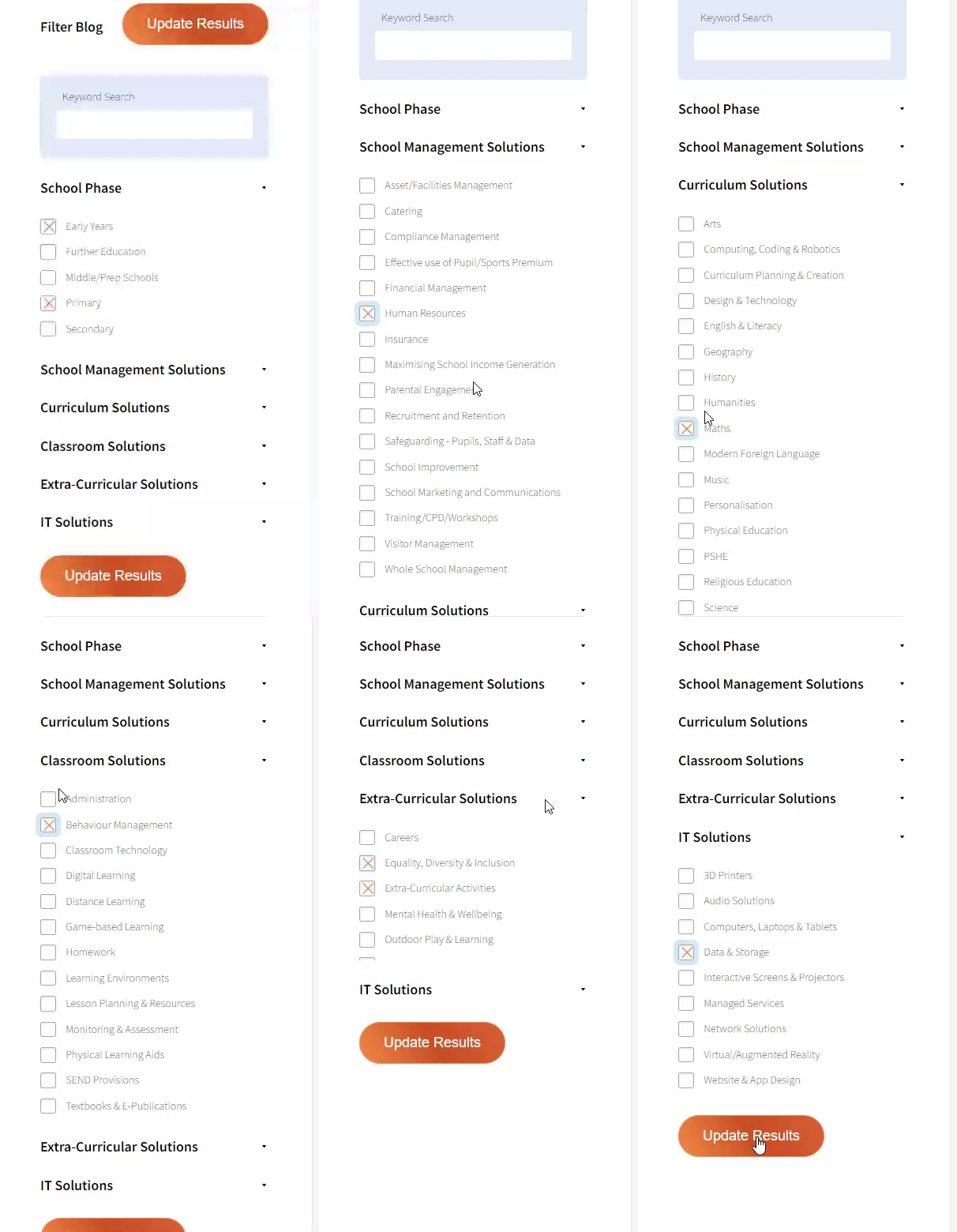
And there you have it! Now your collection of blogs are catered to your chosen topics and are ready for you to explore. Plus, if you frequently return to the same categories you can bookmark your current URL and we will save your choices on return. Happy Reading!
Reflective supervision in school leadership is becoming increasingly important as Headteachers and Executive Leaders navigate safeguarding, SEND, inspection pressure and emotional overload. This article explores how reflective supervision strengthens judgement, culture and sustainable leadership.
It is 5:47pm. The site is almost empty. You are rereading an email for the sixth time because you know the wording could either calm the situation or escalate it. Meanwhile, a safeguarding concern is still sitting heavily in your mind, a parent complaint has arrived and earlier in the day, a member of staff cried in your office. In addition, there is a behaviour decision that cannot wait, a governor question that needs a careful answer, and a corridor full of children who still need you to be calm, visible and present tomorrow morning.
This is the part of school leadership we still do not talk about enough. Not just the workload. Not just the pace. Not just the meetings, policies, emails and deadlines.
Instead, the real weight comes from the expectation that school leaders will continue to think clearly, decide wisely and hold everyone else steady, even when they feel anything but steady themselves. Sometimes the hardest part of leadership is not the decision itself. Rather, it is having to make the decision while everybody else is looking to you for emotional stability. That is why reflective supervision in school leadership matters, because regulation comes before reasoning, and school leaders are human first, leader second.
Most Headteachers and Executive Headteachers do not need another report to tell them leadership is intense, they are living it. However, the evidence still matters because it moves the conversation away from individual resilience and towards the conditions in which leaders are being asked to work. The Teacher Wellbeing Index 2025 reported that 86% of senior leaders feel stressed, 81% experience time poverty, and 71% work to tight deadlines for most of their working time (ascl.org.uk). Those figures are not simply about being busy. Instead, they point to something deeper. Many school leaders are making emotionally complex, high-stakes decisions while emotionally overwhelmed. Leaders now carry safeguarding, SEND, behaviour, attendance, inspection pressure, staffing challenges and parental complaints simultaneously. As a result, very few days feel simple. Likewise, very few decisions come with a perfect answer. More often, leaders must make the next most responsible decision in the middle of competing pressures, incomplete information and emotional strain.
Over time, pressure changes people. Under sustained pressure, leaders often move from reflective thinking into protective thinking. Consequently, the focus narrows from, “What is the best long-term decision?” to, “How do I get through the next twenty-four hours without something collapsing?” That is not weakness. It is human biology. Therefore, leaders need professional structures that help them stay calm, clear and ethically grounded when the work becomes heavy.
Reflective supervision in school leadership is a structured, confidential, non-line-management space where leaders can think deeply about the decisions, relationships and pressures they are carrying. It is not therapy. It is not appraisal. Nor is it somebody telling the Headteacher what to do. Instead, it is structured professional thinking space. At its best, reflective supervision helps a leader slow the situation down enough to see it properly.
What are the facts?
What is the emotion?
What is the legal responsibility?
What is the relational dynamic?
What is being triggered?
What is the fear?
What is the ethical line?
What needs to happen next?
The Supervision in Education Quality Standards Framework, published by the Supervision in Education Network, defines supervision as a safe, collaborative professional learning dialogue supported by clear standards around ethics, supervisor competence and boundaries (stmarys.ac.uk). That matters because reflective supervision in school leadership is not informal offloading. Instead, it is disciplined practice that protects judgement under pressure.
“Reflective supervision gives leaders somewhere safe to think before urgency becomes reactivity.”
In practice, this may mean a Headteacher taking time to think clearly with a supervisor before responding to a serious complaint, safeguarding issue or staffing situation.
One of the quietest pressures in school leadership is the expectation to perform with certainty while internally managing ambiguity. Many leaders have nowhere genuinely safe to think out loud: line management is evaluative; governance is accountability; staff relationships require containment and professional peers may understand, but confidentiality can limit what can be shared. So leaders keep carrying the thinking internally until the internal load becomes invisible but chronic. Leadership is not only cognitive labour, it is emotional containment and constant containment has a cost. This is where reflective supervision in school leadership does something different. It does not remove responsibility from the leader, it strengthens the leader’s capacity to carry it. In high-risk professions, reflective supervision is not viewed as weakness, it is viewed as disciplined practice that protects judgement under pressure. Education should be no different.
In schools, we often expect leaders to move straight into reasoning: analyse the risk; make the decision; write the response; hold the line; stay calm and protect everyone else.
However, human beings do not work like that.
When pressure rises, reasoning narrows. Leaders can become more reactive, more defensive, more controlling or more avoidant. Similarly, people may rush to solve the immediate problem because sitting with complexity feels intolerable. Others may over-function because everybody is looking to them for reassurance.
Importantly, reflective supervision gives leaders a place to regulate before they reason. That matters more than most schools realise. It does not mean avoiding responsibility. Nor does it mean handing the decision to somebody else. Instead, it means noticing what is being carried so that it does not unconsciously shape the decision.
A regulated leader is: more able to stay curious; more able to separate fear from fact; more able to listen properly; more able to hold a boundary without becoming harsh; and more able to act with clarity rather than urgency.
“The quality of a leader’s judgement is directly affected by the condition of the nervous system making the decision.”
That is not soft. It is serious.
In reality, reflective supervision in school leadership often begins with a very ordinary sentence.
“I know what I need to do, but I cannot get clear on why I feel so unsettled by it.”
Or:
“I am holding too many competing pressures, and I need to separate the safeguarding issue from the parental pressure, the staffing issue and my own fear of getting it wrong.”
Sometimes a leader may even say:
“I am worried this decision is starting to become about reputation rather than the child.”
A good supervision session does not make the decision for the leader. Instead, it helps the leader make sense of what is happening around the decision.
Consider a composite example of an Executive Headteacher dealing with a highly contentious permanent exclusion involving a vulnerable pupil. The staff team are exhausted; parents are threatening legal action; the pupil has additional needs; other children have been affected; governors want reassurance. Meanwhile, the local authority has limited placement options. The Headteacher knows a decision must be made, but every route carries risk.
Part of the leader’s anxiety may not only be about the child. It may also involve fear of public criticism, concern about staff morale, legal implications and the private worry that whatever decision is made, somebody will accuse the school of getting it wrong. Without reflective supervision, the leader may move quickly into defensiveness or urgent problem-solving. That is understandable, after all, the system is demanding an answer. Within supervision, however, the decision can be slowed down.
What are the immediate facts?
What has already been tried?
What does the behaviour policy say?
What are the equality considerations?
What is the safeguarding picture?
What is the impact on other pupils and staff?
Where is the leader feeling personally exposed?
What would be a decision they could stand over professionally and morally?
The final decision may still feel difficult. Nevertheless, reflective supervision helps the leader return to the situation with clearer thinking, stronger rationale and greater emotional steadiness. That is not soft leadership, it is disciplined leadership.
A school’s culture is not only shaped by policies, assemblies and improvement plans. It is also shaped by the emotional tone leaders carry into rooms. When leaders become chronically overloaded, pressure often leaks into the system. Leaders may become shorter in meetings. Curiosity can disappear and everything starts to feel urgent. Middle leaders sometimes stop bringing problems because they sense there is no emotional capacity left for them. Similarly, safeguarding conversations can become procedural rather than relational. Emails become sharper. Eventually, staff start surviving the culture rather than contributing to it.
Most leaders do not intend that to happen. However, pressure moves. It moves from the inbox into the corridor; from the safeguarding meeting into the staffroom; from inspection anxiety into the way middle leaders are held to account. This is why reflective supervision in school leadership is not only about individual wellbeing. It is also about culture. When leaders have somewhere safe to think clearly, they are more likely to return to the school community with steadier judgement.
Staff feel that, pupils feel that and families feel that.
“Culture is shaped by the emotional tone leaders carry into rooms.”
As a result, a regulated leader creates calmer, steadier conditions for others. That does not mean lowering expectations. Instead, it means leading with enough internal clarity to hold expectations well.
School leaders are carrying unprecedented levels of emotional and relational complexity: safeguarding thresholds have tightened, parental complaint culture has increased and inspection pressure remains emotionally significant. Meanwhile, staff absence and recruitment challenges continue to stretch leadership capacity.
Reflective supervision in school leadership is no longer a luxury conversation. Increasingly, it is becoming part of how sustainable leadership is protected.
For Designated Safeguarding Leads, Headteachers and Executive Headteachers, the emotional weight of safeguarding is significant. Leaders must hold risk, uncertainty, professional challenge and multi-agency frustration while continuing to make clear decisions. Working Together to Safeguard Children 2026 reinforces that safeguarding is a shared responsibility across organisations and agencies, with a duty to help, protect and promote the welfare of children (gov.uk). That shared responsibility matters.
School leaders know that schools often hold the child every day while wider systems move far more slowly around them. Meanwhile, schools must remain emotionally available to children and families while operating inside systems that are themselves stretched and overwhelmed. Many DSLs are carrying levels of emotional exposure that other caring professions would recognise immediately.
Reflective supervision gives safeguarding leaders space to examine risk, assumptions, thresholds, professional boundaries and emotional impact.
SEND leaders and senior staff are often navigating parental distress, local authority delays, funding constraints, tribunal risk and the daily reality of children whose needs the system is not meeting quickly enough. As a result, many leaders feel caught between advocacy, accountability and capacity.
Reflective supervision in school leadership does not solve the SEND system. However, it can help leaders remain anchored in the best interests of the child while managing the pressure around the child.
Without reflective space, leaders can become consumed by the system battle. With reflective space, they are more likely to retain clarity, compassion and professional judgement.
For too long, school leadership has relied on the idea that the strongest leaders can simply absorb more.
More complexity.
More accountability.
More need.
More emotion.
More pressure.
However, constant emotional containment has a cost. The strongest school leaders are not the ones who feel nothing. Instead, they are the ones who remain thoughtful, ethical and relational while carrying enormous responsibility. No leader can sustain that indefinitely without somewhere safe to process the weight of the role.
Therefore, perhaps the question now needs to change. Instead of asking, “How much more can leaders carry?”, we should ask: “What structures help leaders carry the work well?”
Reflective supervision in school leadership is one of those structures.
It protects judgement, strengthens culture, supports retention and creates room for regulation before reasoning. Most importantly, it recognises something we should never have forgotten, school leaders are not machines for decision-making, They are human beings carrying responsibility for other human beings.
Human first, Leader second.








Are you looking for solutions? Let us help fund them! Nexus Education is a community of over 11,000 schools that come together to share best pract... View More
Established in 2011, One Education is a company at the heart of the education world, supporting over 600 schools and academies. Our unique appeal a... View More
School Space is a social enterprise that has empowered schools for over 14 years through their profitable and hassle-free lettings services. So far... View More
Unify is an online sales and marketing tool that allows users to create tailored personalised documents in moments. View More
There’s nothing special about the energy we sell. In fact, it’s exactly the same energy as all our competitors provide. But there is something spec... View More
Securus provide market-leading monitoring solutions to safeguard students on ALL devices both online and offline. We also offer a full monitoring s... View More
Robotical makes Marty the Robot - a walking, dancing coding robot that makes programming fun and engaging for learners as young as 5. Our robots co... View More