09-03-2020
04:27
Our team sorts through all blog submissions to place them in the categories they fit the most - meaning it's never been simpler to gain advice and new knowledge for topics most important for you. This is why we have created this straight-forward guide to help you navigate our system.
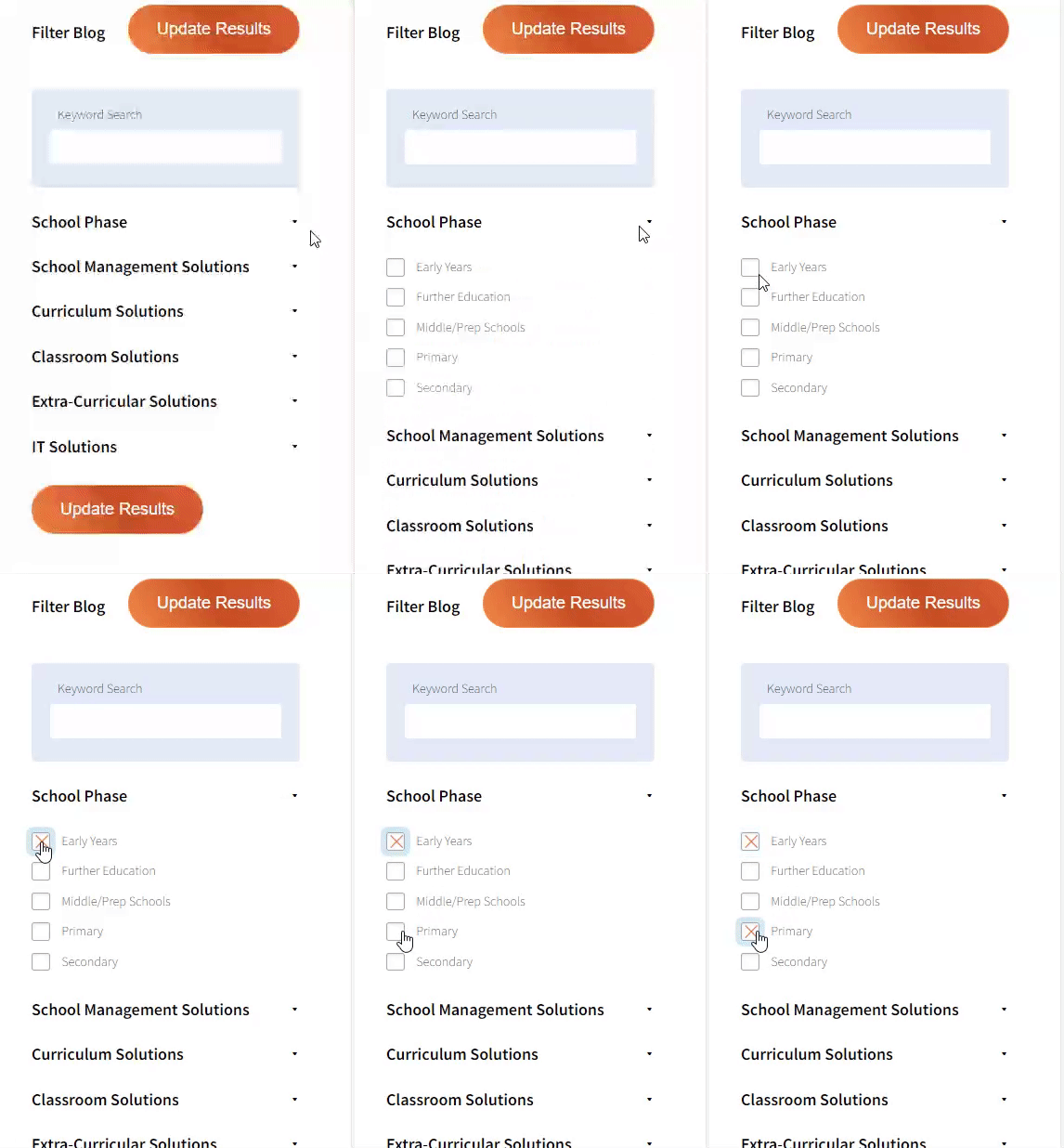
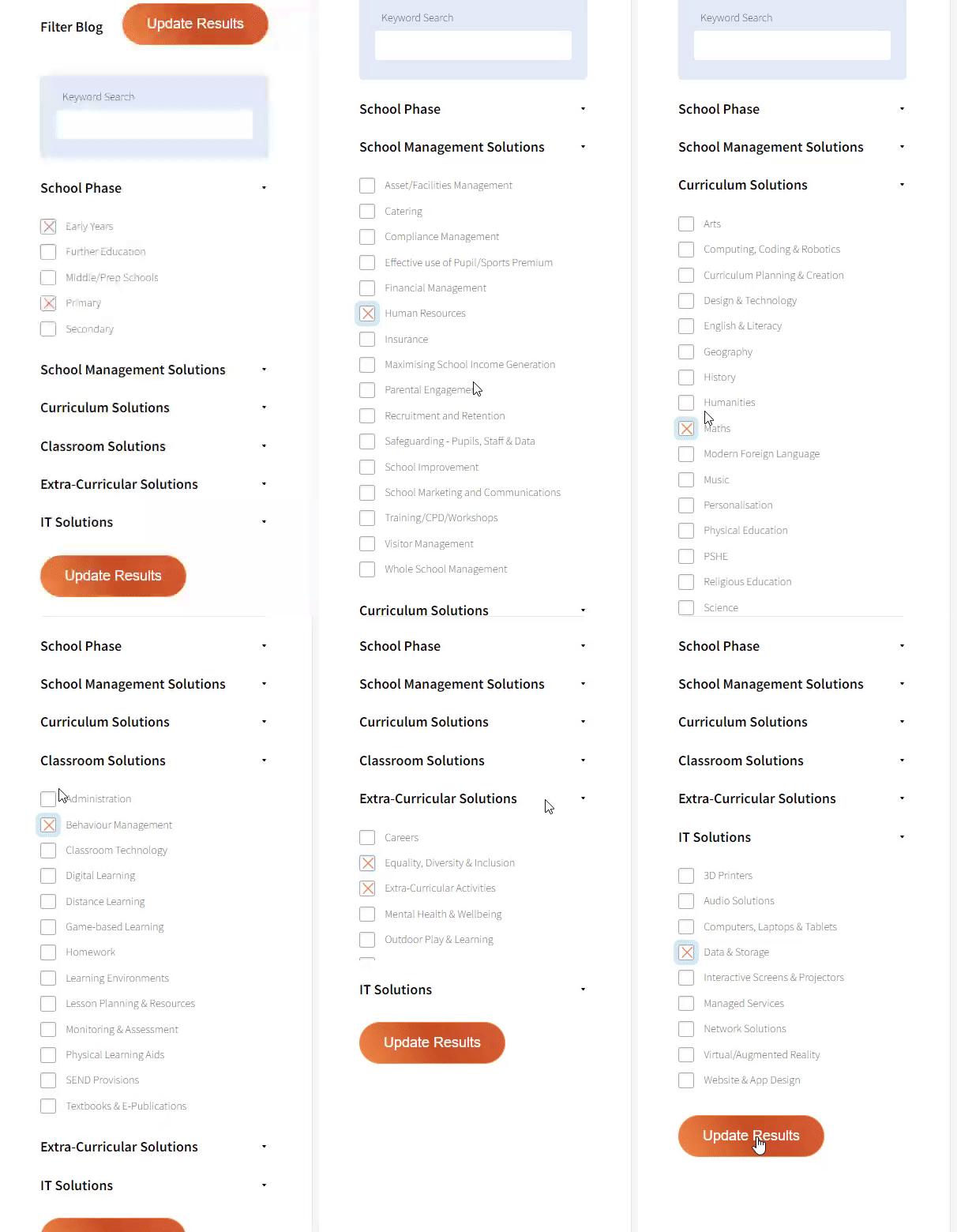
And there you have it! Now your collection of blogs are catered to your chosen topics and are ready for you to explore. Plus, if you frequently return to the same categories you can bookmark your current URL and we will save your choices on return. Happy Reading!
There is a shift happening in inspection conversations. Not loud. Not yet written into new frameworks. But absolutely present in the room.
Inspectors are beginning to look at staff wellbeing and, where leaders bring it into discussion, staff attendance patterns, as indicators of safeguarding culture. Not to scrutinise individuals. Not to question sickness decisions. But to understand whether safeguarding judgement is sustainable.
This is not an HR conversation.
This is a capacity conversation.
And capacity is now a safeguarding issue.
From compliance to capacity
For years, safeguarding assurance has centred on procedural compliance: policies in place, training up to date, thresholds understood, records defensible. All essential. But compliance answers only one question: Are you following process?
Recent inspection activity, including pilot work and the most current reports, is pointing towards something deeper. Inspectors are looking at how systems operate in practice, how consistently they hold under pressure, and whether leadership conditions make sound judgement possible.
The emerging question is clear: Can your organisation sustain safeguarding judgement when the pressure rises?
Safeguarding is cognitive. It is relational. It is judgement-led. And judgement requires capacity.
Safeguarding rarely fails because a policy is missing. It fails because capacity erodes long before anyone names it.
The leadership context we are operating in
Across the sector, the picture is consistent: leaders working long hours, carrying significant emotional labour, and making high‑stakes decisions in conditions of sustained cognitive load. Staff across the system report high levels of stress and pressure, and senior leaders consistently sit at the sharpest end of that curve.
Safeguarding decisions are being made inside that reality. We cannot talk honestly about safeguarding culture without talking about leadership bandwidth.
What safeguarding capacity is
Safeguarding Capacity is the ability of an organisation to sustain timely, proportionate and defensible safeguarding judgement under pressure.
It is not about goodwill. It is not about heroic resilience. It is about structural design.
Capacity is shaped by caseload distribution, the frequency and depth of supervision, the span of control leaders are holding, how decisions are tested and refined, how emotional labour is recognised, and whether leaders have protected thinking time.
When these conditions are weak, safeguarding becomes person‑dependent. And person‑dependent systems are fragile.
What happens when capacity thins
Across leadership and inspection, the pattern is familiar.
When capacity narrows, threshold decisions slow. Leaders hold cases longer than they should. Behaviour systems become reactive. Consistency slips. Escalation anxiety increases.
Research across high‑stakes professions is clear: decision quality deteriorates under sustained overload. Safeguarding is one of the highest‑stakes judgement tasks in education.
When safeguarding capacity thins, referral thresholds drift, escalation slows, recording becomes defensive, and leaders move into protection mode rather than judgement mode.
By the time inspection identifies procedural weakness, structural strain has usually been present for months. The strongest safeguarding files cannot compensate for weakened real‑time judgement.
What recent Ofsted work is signalling
Since late 2025, Ofsted’s pilot inspections and the most recent published reports have begun to surface a more explicit connection between leadership conditions and safeguarding effectiveness. Several themes are emerging consistently.
Inspectors are commenting more directly on workload, role clarity and the distribution of safeguarding responsibilities. Reports increasingly highlight whether safeguarding arrangements are embedded and sustainable, not just compliant. Where safeguarding depends heavily on one or two leaders, this is being noted as a vulnerability. Staff and pupil voice is being triangulated more deliberately. Boards are being evaluated on how well they understand the strain within safeguarding systems, not just whether they receive reports.
The direction of travel is unmistakable: inspection is beginning to assess safeguarding not only through documentation, but through the conditions leaders are working within.
Why attendance patterns matter
When leaders bring staff attendance into the conversation, inspectors are not looking for percentages in isolation. They are looking for insight.
They are asking where emotional load sits in the system, who absorbs risk before it becomes visible, how early leaders detect strain, and what happens if a key safeguarding lead is absent.
Absence becomes intelligence, not accusation.
Patterns can reveal overload in pastoral roles, decision fatigue in DSLs, or leadership bottlenecks that are invisible in policy documentation. An organisation that cannot explain its pressure points cannot convincingly demonstrate safeguarding resilience.
Procedural assurance vs judgement resilience
We are moving from a system that proves safeguarding through paperwork to one that evaluates judgement resilience.
Procedural assurance says: We are compliant.
Judgement resilience says: We remain clear, proportionate and timely even when pressure intensifies.
If safeguarding oversight destabilises when one leader is off sick, capacity was already thin. If supervision disappears when workload rises, it was never infrastructure. If decision‑testing only happens before inspection, resilience is conditional.
This is the uncomfortable edge of the conversation.
This is governance, not goodwill
This shift is not simply about wellbeing. It is about governance.
Boards and governing bodies should now be asking how they monitor safeguarding capacity, not just compliance; how they know emotional labour is distributed sustainably; where judgement is strengthened through structured supervision; and what evidence shows that safeguarding decisions are tested before escalation.
Inspection interest in leadership conditions reflects a broader accountability shift. Safeguarding is no longer demonstrated solely through documentation. It is demonstrated through sustainability.
Designing for capacity
Safeguarding capacity does not happen by accident. It is engineered.
It requires structured reflective supervision, clear caseload distribution, explicit monitoring of emotional labour, protected leadership boundaries, and systems that do not rely on heroic resilience.
One of the most overlooked structural safeguards is disciplined executive supervision – not as wellbeing provision, and not as performance management, but as protected decision‑testing infrastructure.
This is where complex safeguarding judgements are stress‑tested, cognitive load is surfaced early, threshold thinking is refined, and leaders strengthen judgement while pressure is rising, not after it breaks.
If your system relies on over‑functioning individuals, it is not resilient. If safeguarding quality depends on one person’s stamina, it is not secure. If strain is only noticed once absence rises, insight is reactive.
Capacity must be designed, not assumed.
The standard has shifted
Safeguarding has entered a new phase of accountability.
Inspection is no longer simply auditing what is written. It is assessing whether leadership systems can withstand pressure without judgement deteriorating.
Policy proves intention.
Capacity proves sustainability.
The next safeguarding failure will not be about a missing document. It will be about a system that quietly ran out of cognitive and relational bandwidth.
Capacity is now the measure.








Are you looking for solutions? Let us help fund them! Nexus Education is a community of over 11,000 schools that come together to share best pract... View More
Established in 2011, One Education is a company at the heart of the education world, supporting over 600 schools and academies. Our unique appeal a... View More
School Space is a social enterprise that has empowered schools for over 14 years through their profitable and hassle-free lettings services. So far... View More
Unify is an online sales and marketing tool that allows users to create tailored personalised documents in moments. View More
There’s nothing special about the energy we sell. In fact, it’s exactly the same energy as all our competitors provide. But there is something spec... View More
Securus provide market-leading monitoring solutions to safeguard students on ALL devices both online and offline. We also offer a full monitoring s... View More
Robotical makes Marty the Robot - a walking, dancing coding robot that makes programming fun and engaging for learners as young as 5. Our robots co... View More