02-02-2022
10:42
Our team sorts through all blog submissions to place them in the categories they fit the most - meaning it's never been simpler to gain advice and new knowledge for topics most important for you. This is why we have created this straight-forward guide to help you navigate our system.
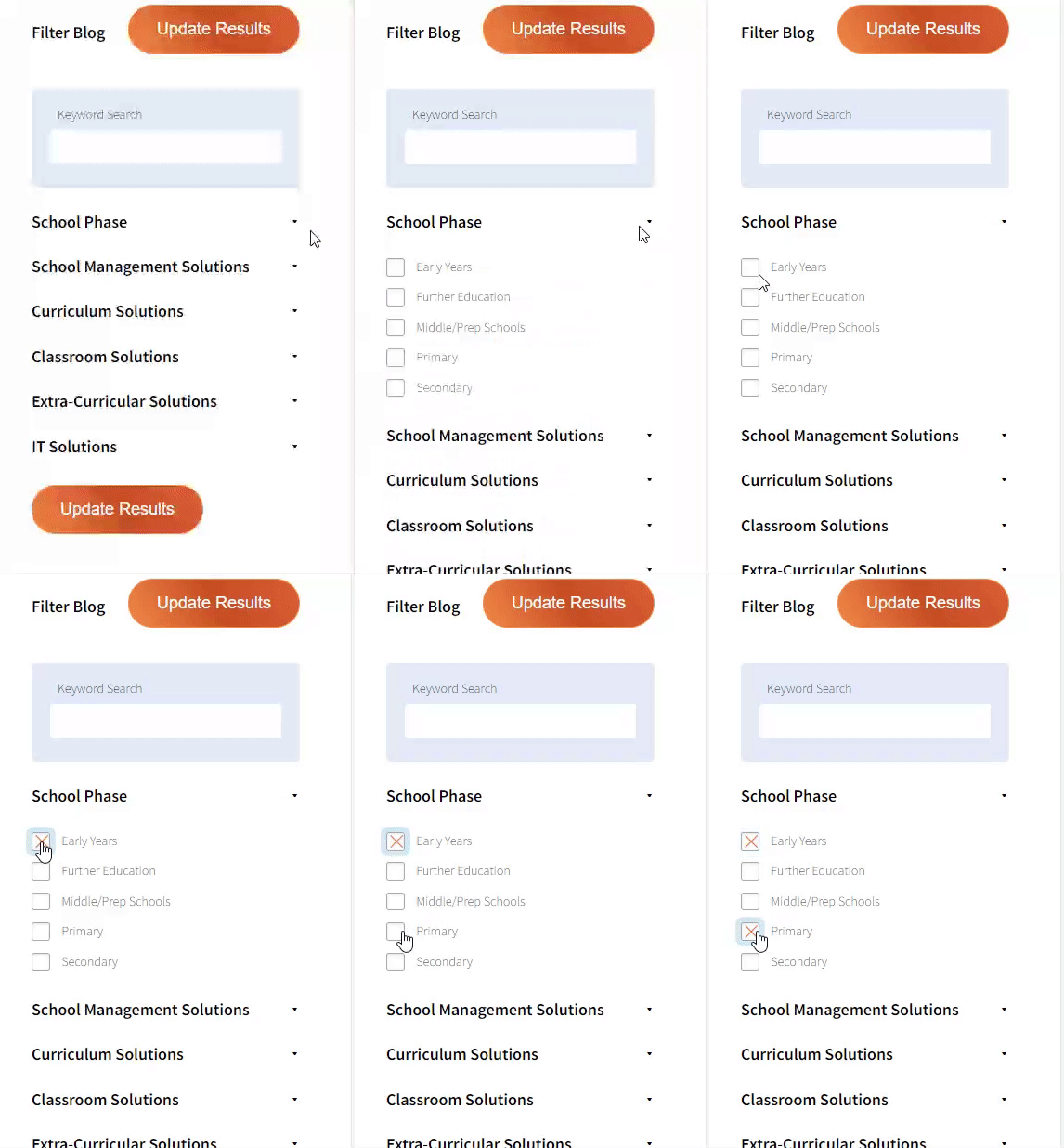
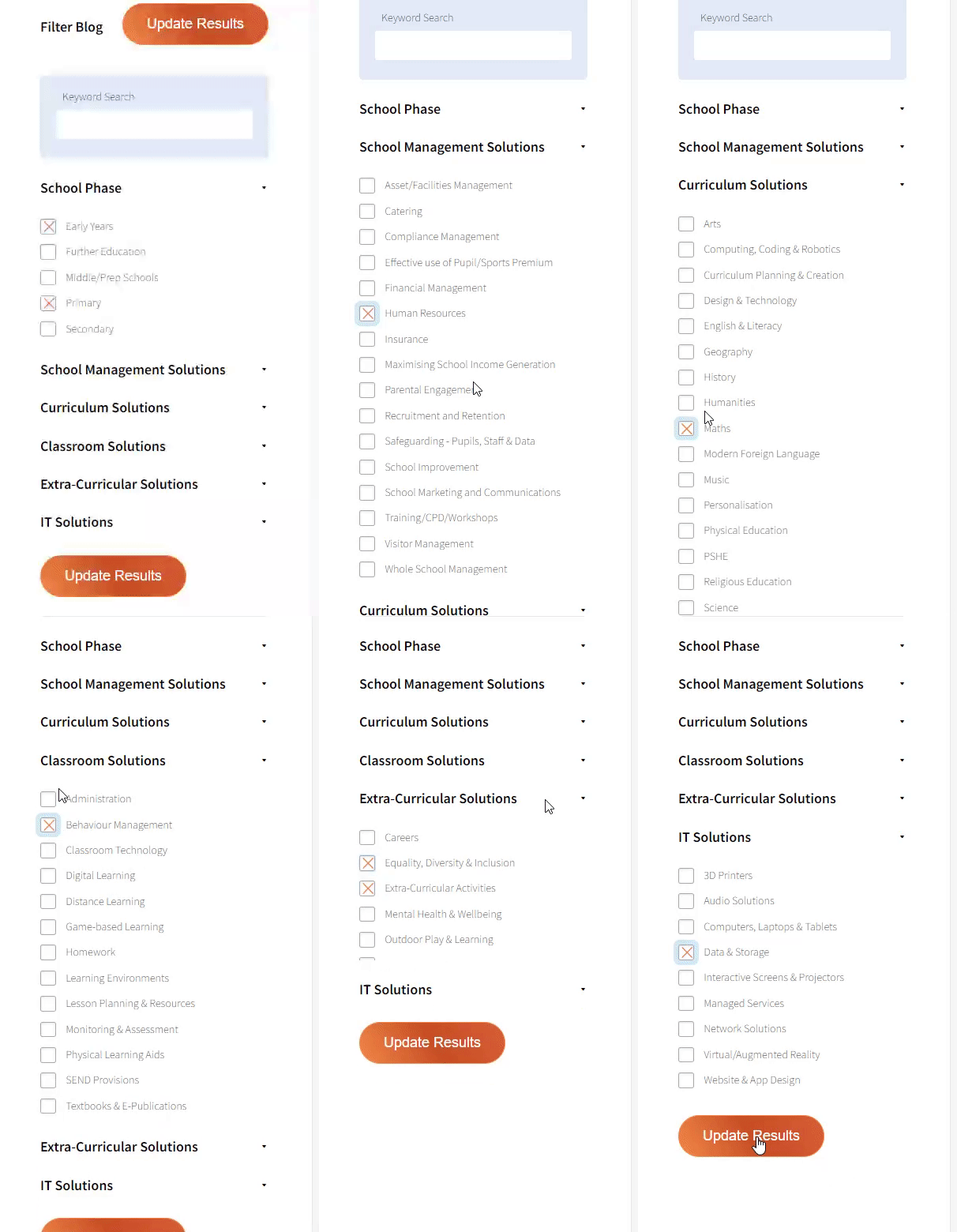
And there you have it! Now your collection of blogs are catered to your chosen topics and are ready for you to explore. Plus, if you frequently return to the same categories you can bookmark your current URL and we will save your choices on return. Happy Reading!
Teachers in the UK are working an average of 51.9 hours per week, according to the DfE’s 2024 Working Lives of Teachers survey. That figure has barely shifted in a decade. And it is not the teaching that exhausts people. It is the preparation, the differentiation, the marking, the admin that sits between you and the students you came into this profession to teach.
AI tools are starting to change this. Not by replacing the professional judgement that good teaching requires, but by handling the repetitive groundwork that consumes evenings and weekends. The result, when done well, is not a shortcut. It is more time to do the things that actually matter.

Here are four specific ways AI can reduce your preparation time while improving what happens in the classroom.
Most teachers know they should differentiate more than they do. The research is clear: Tomlinson’s work on differentiated instruction shows that matching task complexity to student readiness produces significantly better outcomes. The problem has never been knowledge. It has been time.
Creating three versions of a worksheet for a single lesson takes the better part of an evening. AI can produce differentiated versions of a resource in under five minutes. You describe the learning objective, specify the ability levels, and refine the output. The professional skill is still yours: deciding what gets taught, how the scaffolding works, which students need which version. AI handles the production.
In practice: A Year 8 science teacher planning a lesson on photosynthesis can generate a core worksheet, a supported version with sentence starters and labelled diagrams, and an extension version with open-ended application questions. Instead of spending ninety minutes creating three documents, she spends fifteen minutes reviewing and adjusting them. The remaining time goes into thinking about how she will actually teach the lesson.
Effective formative assessment depends on asking the right questions. Dylan Wiliam’s research on Assessment for Learning demonstrates that well-designed hinge questions can tell a teacher within thirty seconds whether students have grasped a concept or need a different approach.
Writing those questions is harder than it looks. A good hinge question needs plausible distractors rooted in common misconceptions, not just wrong answers. AI is genuinely useful here because it can draw on extensive knowledge of typical student errors and produce diagnostic multiple-choice options that map to specific misunderstandings.
In practice: A maths teacher preparing a lesson on adding fractions asks AI to generate hinge questions where each incorrect answer reflects a known misconception (adding numerators and denominators separately, forgetting to find a common denominator, simplifying incorrectly). She now has a quick diagnostic tool that tells her not just who is struggling, but exactly where their thinking has gone wrong. That kind of responsive teaching used to require significant advance preparation. It still requires a skilled teacher to act on the information, but the question design itself takes minutes.
Cognitive science tells us that retrieval practice is one of the most effective learning strategies we have. Rosenshine’s Principles of Instruction place daily review at the top of the list. Yet building varied, purposeful starter activities for every lesson is the kind of task that quietly eats planning time.
AI can generate retrieval quizzes, low-stakes knowledge checks, and interleaved review questions tied to previous learning objectives. The output is a starting point. You know your class, their gaps, and what they covered last Tuesday. But having a draft to work from is dramatically faster than starting from nothing.
In practice: A history teacher covering the causes of the First World War asks AI to generate a five-question retrieval starter that revisits last week’s content on the alliance system. The questions mix recall (name the two main alliance blocs) with application (explain why the alliance system made a local conflict more likely to spread). She tweaks one question that is too easy, adds a bonus challenge for her strongest students, and has a purposeful lesson opener ready in under five minutes.
There are moments in teaching when you need a well-structured model answer or a clear written explanation to share with students. Writing these from scratch is time-consuming, particularly when you are teaching across multiple year groups or subjects outside your specialism.
AI can produce model answers that follow a specific structure (PEEL paragraphs, for example), or explanations pitched at a particular reading level. The output gives you raw material to refine. You can annotate it, highlight the structural features you want students to notice, or deliberately introduce an error for students to find and correct.
In practice: An English teacher preparing for a GCSE Literature mock generates a model response to an extract question on A Christmas Carol. She uses it not as something to hand out, but as a teaching tool: projecting it on the board, asking students to identify where the candidate uses evidence, where the analysis could be sharper, and what grade they would give it. The AI-generated draft becomes the basis for a genuinely analytical classroom discussion.
None of this requires an overhaul of how you teach. Pick one task that reliably takes too long; resource differentiation, quiz creation, starter activities. Try using AI for that single task for a week and see what happens to your time.
The goal is not to automate teaching. Teaching is a fundamentally human act that depends on relationships, professional judgement, and knowing your students. The goal is to automate the production work that sits around the teaching, so that more of your working week is spent on the parts of the job that drew you to it in the first place.
The workload crisis will not be solved by telling teachers to work harder or manage their time better. But giving teachers tools that handle the mechanical preparation, while preserving their professional autonomy over what and how they teach, is a step worth taking.







Are you looking for solutions? Let us help fund them! Nexus Education is a community of over 11,000 schools that come together to share best pract... View More
Established in 2011, One Education is a company at the heart of the education world, supporting over 600 schools and academies. Our unique appeal a... View More
School Space is a social enterprise that has empowered schools for over 14 years through their profitable and hassle-free lettings services. So far... View More
Unify is an online sales and marketing tool that allows users to create tailored personalised documents in moments. View More
There’s nothing special about the energy we sell. In fact, it’s exactly the same energy as all our competitors provide. But there is something spec... View More
Securus provide market-leading monitoring solutions to safeguard students on ALL devices both online and offline. We also offer a full monitoring s... View More
Robotical makes Marty the Robot - a walking, dancing coding robot that makes programming fun and engaging for learners as young as 5. Our robots co... View More